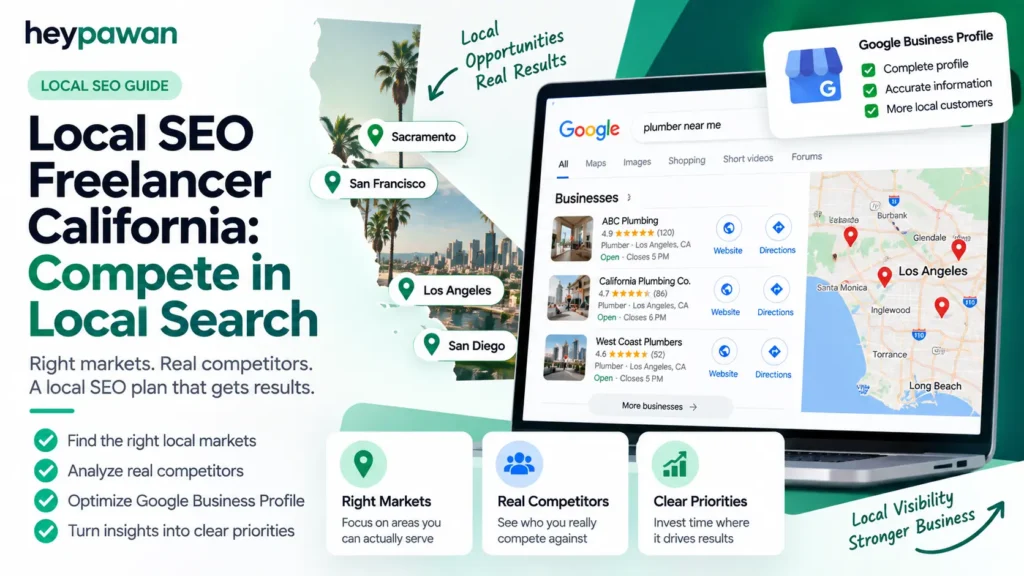
A Local SEO Freelancer California business owners evaluate should do more than recommend reviews, citations, location pages, and Google Business Profile updates. The first job is to identify where the business can realistically compete for customers, which businesses it competes against there, and which search surfaces matter.
That distinction matters because California is not one local search market. A business may have strong visibility around one location and weak visibility in another. The right Local SEO plan starts with those market differences, then decides where time and budget should go.
California Is Not One Local Search Market
Google says local results are primarily influenced by relevance, distance, and prominence. Distance is based partly on how far a business is from the location used in the search. That alone makes a statewide Local SEO strategy too broad for many businesses.
A dentist in one California city, a contractor serving several nearby communities, and a company with multiple legitimate locations do not compete under the same geographic conditions.
The useful question is not, “How do we rank across California?” It is:
Where can this business realistically acquire customers, and what does local competition look like in those specific markets?
That keeps Local SEO tied to real business reach rather than a long list of city keywords.
If the problem is broader than location-based visibility, a broader California SEO strategy may be the better starting point.
Define the Local Markets Your Business Can Realistically Serve
Your Local SEO target area should reflect where the business genuinely operates and serves customers.
For a storefront, that may center on the location and surrounding customer area. A service-area business may travel to customers across several communities. A multi-location company may need separate analysis around each legitimate location.
Google’s Business Profile guidelines make these operational distinctions important. Service-area businesses that do not serve customers at their address can hide that address and specify service areas. Google currently allows up to 20 service areas and advises businesses to keep them specific and accurate, with the overall area generally staying within about two hours’ driving time from the business base.
Those settings should represent reality, not be treated as a shortcut for ranking in more cities.
Before adding another California market to an SEO plan, check:
- Can the business actually serve customers there efficiently?
- Is the service commercially important enough to justify the effort?
- Does the company have a legitimate operational reason to target that market?
- Is this an existing customer area or only a hoped-for expansion market?
A city should enter the Local SEO plan because it makes business sense, not simply because a keyword tool shows searches there.
Compare the Competitors and Search Surfaces That Matter in Each Market
The right Local SEO competitors are the businesses that actually compete for relevant searches in the market you want to serve. They are not necessarily the largest companies in California or the businesses you consider competitors offline.
For example, one set of businesses may appear prominently in Google Maps for a service near your location, while different websites compete strongly in localized organic results.
That means competitor research should connect three things:
the query, the market, and the search surface.
A freelancer should be able to determine:
- Which businesses repeatedly appear for commercially important searches;
- Whether your main opportunity is in Maps/local results, localized website results, or both;
- Whether the competitors change as the target area changes;
- What those competitors appear to do better or differently.
AI-assisted Google Search can also be considered where relevant, but it should not become a separate collection of “AI SEO hacks.” Google’s current guidance says its generative AI Search features continue to rely on established SEO fundamentals.
For deeper AI-specific preparation, see the AI SEO readiness checklist for small businesses.
Local SEO Freelancer California: Turn the Competition Map Into Priorities
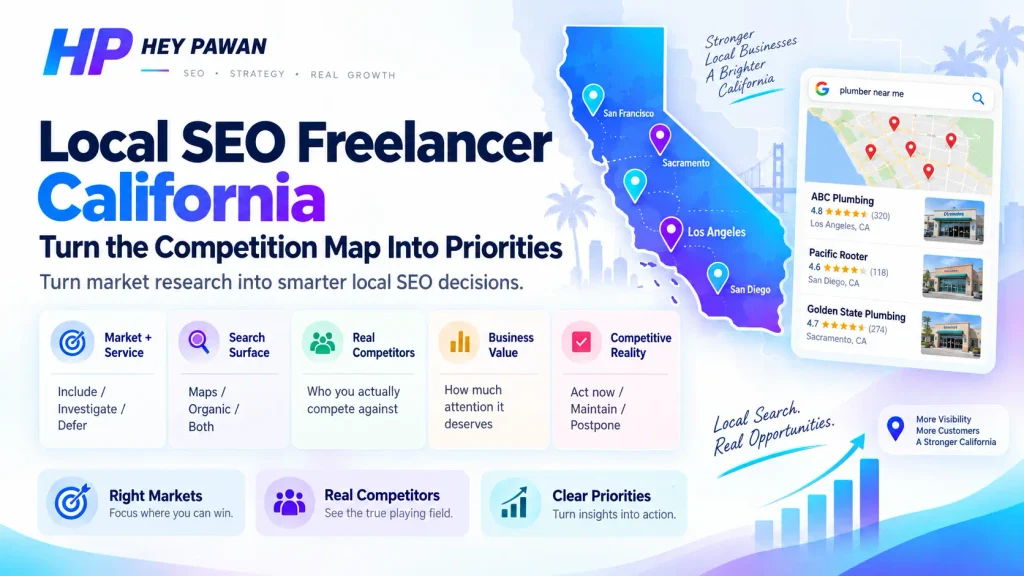
A strong Local SEO Freelancer California strategy should turn market research into priorities rather than applying the same checklist everywhere.
A practical way to do that is a Local Search Competition Map:
| What to map | What to determine | Decision |
| Market + service | Where customers can realistically be won | Include, investigate, or defer |
| Search surface | Maps, localized organic results, or both | Where visibility matters |
| Real competitors | Businesses appearing for the relevant query and location | Who must actually be compared |
| Business value | Commercial importance of the market | How much attention it deserves |
| Competitive reality | Current visibility and difficulty | Act now, maintain, or postpone |
This prevents tactics from becoming the strategy.
A new location page might be justified in one market. Another market may first need stronger Business Profile accuracy or clearer service relevance. A third may not deserve investment yet because the business cannot serve it efficiently.
Reviews, citations, local links, technical improvements, and on-page work still matter when evidence supports them. The difference is that they become responses to a defined competitive problem, not automatic items added to every Local SEO package.
That makes the plan easier to evaluate because each activity has a reason tied to a market and business outcome.
Judge the Freelancer by the Local Decisions They Can Explain
The most useful provider test is whether the freelancer can explain the local decisions behind the proposed work.
Ask questions such as:
- Which customer market should receive attention first, and why?
- Which searches and businesses define the competition there?
- Is the bigger opportunity in Maps/local results or website visibility?
- Which market would you postpone?
- What evidence would make you change the priority?
Google’s own SEO hiring guidance recommends evaluating whether a provider understands the business, customers, competitors, and the reasoning behind their recommendations. A long list of Local SEO services does not prove that.
Be cautious with anyone promising guaranteed Map Pack positions. Google says businesses cannot pay for better organic local placement, and its third-party policies prohibit guarantees of top placement.
General questions about contracts, account access, reporting, and handover are better handled through a broader digital marketing freelancer hiring checklist.
If your California business has several possible service areas, inconsistent local visibility, or conflicting advice about what to optimize first, you can share your website, business model, important services, and actual customer geography with Hey Pawan. Pawan Kumar works as one independent digital marketing professional with 10+ years of experience and can assess whether the problem fits a clearly defined remote Local SEO engagement.
Frequently Asked Questions
Does a Local SEO freelancer need to live in California?
Not necessarily. Google’s SEO hiring guidance suggests asking about a provider’s experience in your country or city, but it does not state that the provider must live in the target market. For remote Local SEO work, understanding the business, customer geography, competitors, and relevant search environment matters more than claiming local residence.
Who should own the Google Business Profile when a freelancer manages it?
The business should retain ownership or co-ownership. Google’s third-party policies say clients must retain ownership or co-ownership of their Business Profile, while outside providers can receive appropriate management access for the work they are authorized to perform.
Sources
Google Business Profile Help — Tips to improve your local ranking on Google
https://support.google.com/business/answer/7091?hl=en
Google Business Profile Help — Manage your service areas
https://support.google.com/business/answer/9157481?hl=en
Google Business Profile Help — Guidelines for representing your business on Google
https://support.google.com/business/answer/3038177?hl=en
Google Business Profile Help — Business Profile third-party policies
https://support.google.com/business/answer/7353941?hl=en
Google Search Central — Do you need an SEO?
https://developers.google.com/search/docs/fundamentals/do-i-need-seo
Google Search Central — Google’s Guide to Optimizing for Generative AI Features on Google Search
https://developers.google.com/search/docs/fundamentals/ai-optimization-guide