Small-business owners are increasingly hearing about AI SEO, AEO, GEO, Google AI Overviews, ChatGPT Search, and other new ways customers discover information. The difficult question is not whether AI Search exists. It is whether your website needs a completely different optimization strategy to participate in it.
For most businesses, AI SEO for small business starts with stronger SEO fundamentals, not a separate collection of AI tricks. Your important pages need to be crawlable, indexable, useful, clearly connected to your services, supported by credible information, and measurable.
A small business does not need to replace traditional SEO with a separate AI-only strategy. Google says its generative Search features are rooted in core Search ranking and quality systems, and no special AI markup is required. The practical priority is to improve technical access, page clarity, useful content, trust signals, internal relationships, and measurement while accounting for platform-specific requirements such as ChatGPT Search crawler access.
What Does AI SEO Mean for a Small Business?
AI SEO means preparing useful website content to perform well in traditional search while also making it easy for AI-assisted discovery systems to retrieve, understand, and reference relevant information.
It does not mean abandoning keyword research, technical SEO, internal links, service pages, or useful content.
Google’s current guidance is unusually clear on this point. Its AI Overviews and AI Mode rely on Google’s core Search systems, so established SEO principles continue to matter. Google also describes AEO and GEO as terms used for work focused on AI-search visibility, while stating that from Google’s perspective this work is still part of optimizing the search experience.
For a small business, that means the practical questions remain familiar:
- Can search systems access the site?
- Are important pages indexed?
- Does each page have a clear purpose?
- Can visitors understand the service quickly?
- Does the content answer genuine customer questions?
- Is the business identity clear?
- Can performance be measured?
AI Search adds new discovery environments, but it does not make those fundamentals obsolete.
Does AI SEO Replace Traditional SEO?
No. AI SEO should extend traditional SEO rather than replace it.
Google states that there are no additional requirements to appear in AI Overviews or AI Mode beyond the normal requirements and best practices that apply to Google Search.
That distinction matters because businesses can waste time implementing supposed AI-search hacks while basic problems remain unresolved.
For example, a business might create new AI-focused articles while:
- important service pages remain unindexed
- several pages target the same intent
- internal linking is weak
- service descriptions are vague
- search traffic reaches informational pages but not commercial pages
- conversion tracking cannot distinguish useful enquiries from low-quality activity
Those problems should normally be investigated before adding another AI-specific tactic.
In my experience, businesses often want to change content first because content is visible and easy to edit. I prefer to confirm technical access, page targeting, internal relationships, and measurement before deciding what new content is actually required.
Can Google and AI Search Systems Access Your Important Pages?
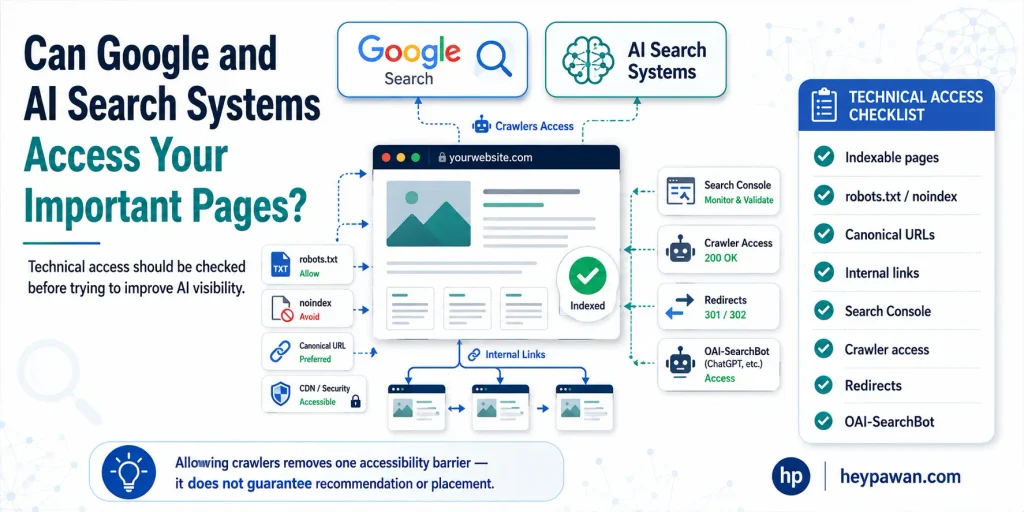
Technical access should be checked before trying to improve AI visibility.
For Google’s generative Search features, a page must be indexed and eligible to appear in Google Search with a snippet. Google also states that meeting technical requirements does not guarantee crawling, indexing, or inclusion.
A practical first check includes:
- Confirm that priority service and product pages are indexable.
- Review robots.txt and noindex instructions.
- Check canonical URLs on important pages.
- Make sure valuable pages have crawlable internal links.
- Review Google Search Console for indexing or crawl issues.
- Check whether hosting, security tools, or a CDN block legitimate crawlers.
- Confirm that redirects and old URLs are handled correctly after redesigns or migrations.
ChatGPT Search has a separate platform-specific consideration. OpenAI says websites that want to be eligible for inclusion should allow OAI-SearchBot and ensure that the site’s host or CDN permits traffic from OpenAI’s published searchbot IP addresses. Placement is not guaranteed.
Allowing a crawler does not mean an AI system will recommend your business. It simply removes one possible accessibility barrier.
Is Your Website Clear About What You Do and Who You Help?
A website should make the relationship between the business, service, audience, and page purpose explicit.
A visitor should not need to interpret vague branding language to understand:
- who provides the service
- what the service includes
- which problem it addresses
- who it is intended for
- where the business operates when location matters
- what the next action should be
This clarity also helps create stronger relationships between pages.
For example, a technical SEO article should naturally lead to relevant SEO service information. A local SEO article should connect to the location or local-service context it supports. A website-design page should explain how structure, navigation, mobile usability, internal links, and tracking fit together.
Hey Pawan’s website-design service follows this principle by treating crawlable navigation, heading hierarchy, internal linking, URL structure, mobile usability, metadata, analytics, and conversion tracking as website foundations rather than isolated tasks.
Clarity is more useful than trying to insert every possible semantic term into one page.
Does Your Content Answer Questions Customers Actually Ask?
Useful AI-search content should answer real questions directly and then provide enough context for the answer to be trustworthy.
That usually means:
- identify the actual search intent
- answer the core question near the beginning
- explain important conditions or limitations
- provide practical steps where useful
- distinguish facts from professional judgment
- cite primary sources for platform-specific claims
- add original observations rather than summarizing common advice
- link naturally to deeper pages when the reader needs more detail
Google’s current generative AI guidance emphasizes unique, non-commodity content and specifically warns against creating large numbers of pages just to capture possible query variations.
This is particularly important for small-business websites. Ten genuinely useful pages can build a clearer subject relationship than dozens of near-duplicate articles that say the same thing with slightly different keywords.
Do You Need llms.txt or Special Schema for Google AI Search?
Not for Google Search.
Google’s July 2026 guidance says websites do not need special machine-readable AI files, special markup, or llms.txt to appear in Google Search or its generative AI features. Google also states that llms.txt does not help or hurt Google Search visibility because Google Search ignores it.
Structured data still has legitimate SEO uses, but it should not be presented as a special AI-ranking requirement. Google says there is no special Schema.org markup required for generative Search.
A sensible approach is:
Required foundation: useful, accessible, indexable content.
Useful when relevant: accurate structured data that matches visible page information.
Not a Google AI requirement: llms.txt, special AI schema, artificial content chunking, or rewriting every page solely for AI systems.
That distinction can prevent a small business from spending time on speculative tactics while more important SEO problems remain unresolved.
How Should You Measure Google and AI Search Visibility?
Measure AI SEO through search visibility and business outcomes rather than relying on a single ranking number.
Useful measurement can include:
- indexed priority pages
- relevant search queries
- impressions
- clicks
- landing-page performance
- qualified enquiries or conversions
- branded and non-branded visibility
- Search Console AI-feature performance where available
- identifiable AI referral traffic
- changes in lead quality
Google’s current guidance points website owners to the Generative AI performance report in Search Console for understanding how content performs in Google’s generative Search features.
AI referral traffic should still be interpreted carefully. A visit from an AI platform is not automatically a lead, and a lead is not automatically qualified.
Measurement should answer a business question, such as:
Are more relevant prospects discovering important pages, understanding the service, and completing meaningful actions?
That is more useful than reporting visibility without context.
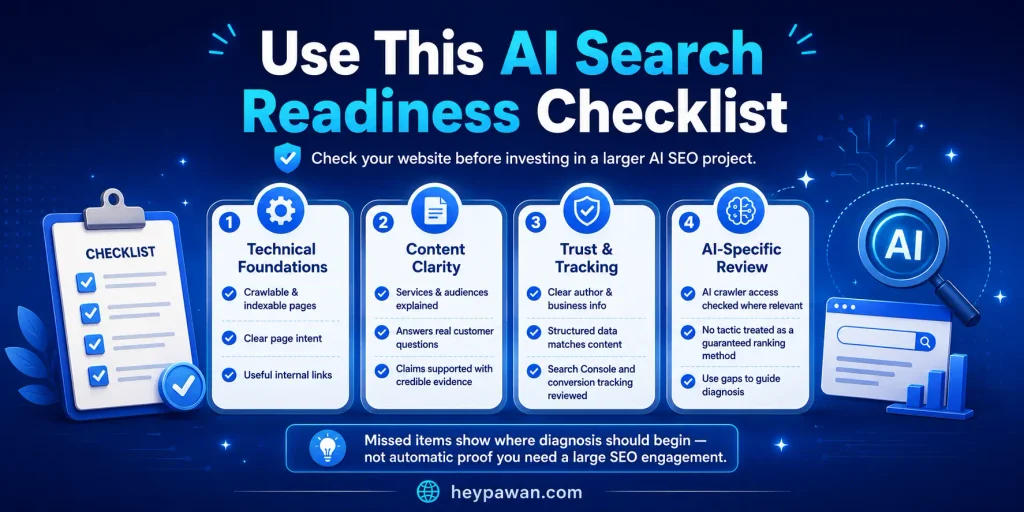
Use This AI Search Readiness Checklist
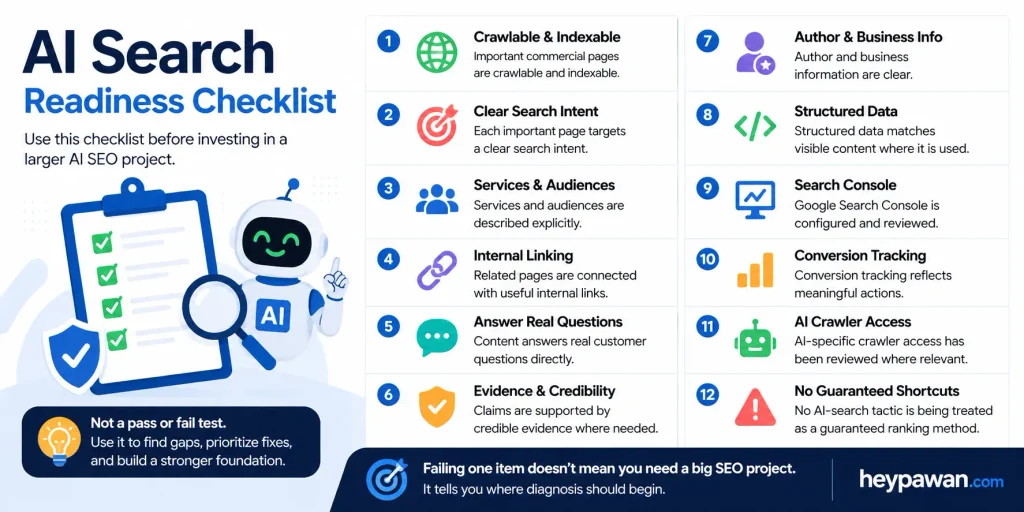
Before investing in a larger AI SEO project, check the following:
- Important commercial pages are crawlable and indexable.
- Each important page targets a clear search intent.
- Services and audiences are described explicitly.
- Related pages are connected with useful internal links.
- Content answers real customer questions directly.
- Claims are supported by credible evidence where needed.
- Author and business information are clear.
- Structured data matches visible content where it is used.
- Google Search Console is configured and reviewed.
- Conversion tracking reflects meaningful actions.
- AI-specific crawler access has been reviewed where relevant.
- No AI-search tactic is being treated as a guaranteed ranking method.
Failing one item does not automatically mean you need a large SEO engagement. It tells you where diagnosis should begin.
When Should a Small Business Get Professional SEO Help?
Professional help becomes more useful when the problem cannot be isolated through basic checks.
A business may reasonably handle simple content updates, contact-information corrections, and straightforward page improvements internally.
Specialist support becomes more relevant when you are dealing with:
- indexing problems
- technical crawl barriers
- site migrations
- competing pages and keyword cannibalization
- unclear service-page targeting
- large content architecture decisions
- structured-data errors
- persistent visibility loss
- unreliable conversion tracking
- AI Search visibility that cannot be separated from broader SEO problems
Google itself lists site-structure reviews, technical website advice, content development, keyword research, market expertise, and optimization for generative AI among the types of work professional SEOs may perform.
The first goal should be diagnosis, not automatically committing to a large package.
Need Help Diagnosing Your SEO and AI Search Gaps?
Hey Pawan is the professional brand of Pawan Kumar, an independent digital marketing freelancer working directly with businesses on SEO and AI Search problems.
If your website has technical indexing issues, weak service-page visibility, unclear search targeting, content overlap, or uncertain AI Search readiness, you can share the website and current challenge with me. I can review the context, identify the most important issues, and recommend a practical next step without promising rankings or AI citations.
Use the Pawan Marketing contact page to send your website and project details.
Frequently Asked Questions
Is AI SEO different from traditional SEO?
AI SEO considers visibility in AI-assisted search and answer experiences, but it still depends heavily on traditional SEO foundations. Google says its generative Search features use core Search ranking and quality systems, so crawlability, indexation, useful content, technical clarity, internal linking, and search intent continue to matter.
Does my small business need llms.txt or special AI schema?
Not for Google Search. Google’s current guidance says llms.txt does not improve or reduce Google Search visibility because Google ignores it. Google also says no special Schema.org markup is required for its generative AI Search features. Normal structured data can still be useful when it accurately describes visible page content.
How can I check whether Google can access my important pages?
Start with Google Search Console and review indexing status for priority URLs. Check robots.txt, noindex directives, internal links, canonical URLs, redirects, and technical errors that may prevent crawling or indexing. A page generally needs to be indexed and eligible for a normal Search snippet before it can appear in Google’s generative Search features.
How can I make my website eligible for ChatGPT Search?
OpenAI says websites seeking eligibility for ChatGPT Search should allow OAI-SearchBot and ensure their hosting or CDN does not block OpenAI’s published searchbot traffic. This only addresses accessibility. OpenAI explicitly says placement is not guaranteed, so crawler access should not be treated as a ranking promise.
When should a small business hire an SEO specialist?
Consider specialist help when basic changes do not explain the problem, or when the work involves technical indexing, migrations, overlapping pages, site architecture, structured data, search-intent mapping, measurement, or persistent visibility issues. A useful first engagement should identify the cause and priorities before expanding the scope.
Sources
- Google Search Central: Optimizing Your Website for Generative AI Features on Google Search
Google Generative AI Search Optimization Guide (Google for Developers) - Google Search Central: AI Features and Your Website
Google AI Features and Your Website (Google for Developers) - Google Search Central: Creating Helpful, Reliable, People-First Content
Google Helpful Content Guidance (Google for Developers) - OpenAI Help Center: Searching the Web with ChatGPT
OpenAI ChatGPT Search Documentation (OpenAI Help Center) - Google Search Central: Do You Need an SEO? Tips for Hiring an SEO
Google SEO Hiring Guidance (Google for Developers)