A proposal can include technical SEO, keyword research, content, links, Local SEO, reporting, and AI search optimization and still lack a clear strategy. When evaluating an SEO Freelancer in California, the more important question is not how many activities are included. It is whether those activities solve the right search problem in the right order.
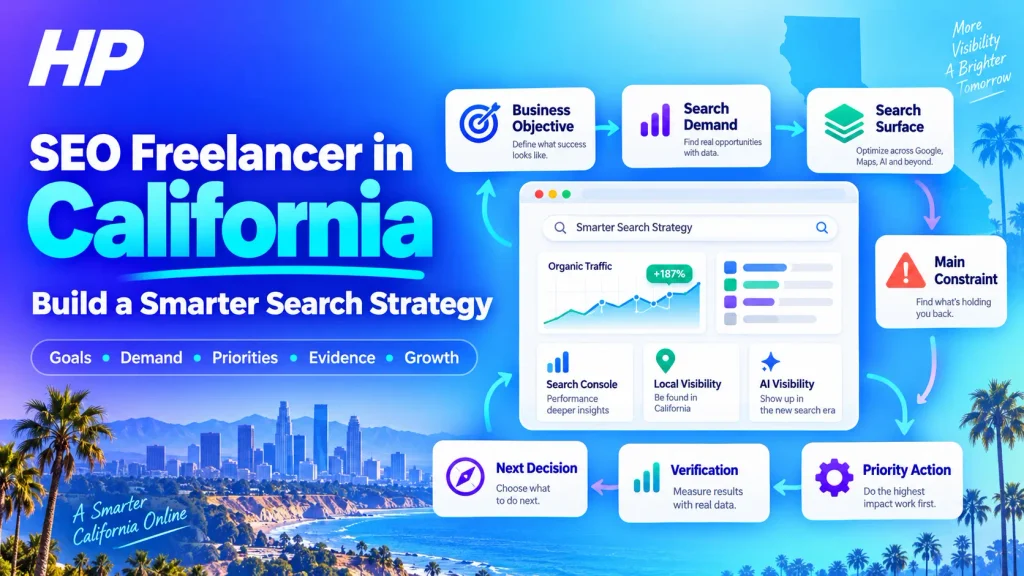
A sound SEO strategy should connect your business objective with real search demand, the search surfaces that matter, the strongest current constraint, a defensible priority, and evidence that determines what happens next.
A List of SEO Tasks Is Not Yet a Search Strategy
Technical fixes, new pages, backlinks, Local SEO, and AI search optimization can all be legitimate work. Their presence in a proposal does not automatically make the proposal strategically sound.
The difference is reasoning.
Google recommends evaluating whether an SEO understands your business, customers, competitors, and how Search fits into your business goals. It also advises businesses to understand the reasoning behind significant recommendations rather than accepting proposed changes without scrutiny.
For each major recommendation, you should be able to understand:
- what search problem or opportunity it addresses;
- why it matters to your business;
- why it deserves attention now;
- what evidence supports the recommendation;
- what should happen after the work is completed.
That is different from simply receiving a monthly list of deliverables.
If your main concern is who should implement, coordinate, or verify individual SEO tasks, the separate Hey Pawan guide to SEO freelancer responsibilities covers that question in more detail.
Build the Strategy Around the Search Opportunity and Main Constraint
A strong strategy begins with the search opportunity that could matter commercially and then identifies what currently prevents the business from capturing it.
A practical way to evaluate the proposal is to follow this sequence:
| Strategy question | What you need to establish |
| Business objective | What useful customer action should organic search support? |
| Search demand | What are potential customers actually searching for? |
| Search surface | Does discovery happen through standard results, local results, or other relevant Search experiences? |
| Main constraint | What currently prevents useful visibility or action? |
| Priority action | What work best addresses that constraint now? |
| Verification | What evidence will show whether the assumption was correct? |
| Next decision | Continue, adjust, expand, or solve a different problem? |
The constraint will not be the same for every website.
A useful service page may not be indexed correctly. Another site may be technically accessible but have pages that do not match the searcher’s intent. A local business may have a geographic visibility problem, while a national company may need stronger topic coverage or authority.
Google Search Console can help test these assumptions through query, page, country, impression, and click data.
AI-assisted search can also be part of this map where relevant, but it should not automatically create a second strategy. Google says optimizing for generative AI Search is still SEO and recommends prioritizing effective SEO strategies over unsupported AEO/GEO hacks.
For a deeper website-readiness discussion, see the Hey Pawan AI SEO readiness checklist.
Make the Priority Order Defensible
Finding ten SEO issues does not mean all ten deserve equal attention. The proposed order should reflect dependencies, commercial importance, and evidence.
Use four questions to test each major recommendation:
- What problem or opportunity does this address?
- What evidence makes it important now?
- Why should it happen before another SEO activity?
- What result or new evidence would change the next decision?
Consider a site with an important page that Google cannot properly access or index. Publishing several more similar pages may be a lower priority until the technical constraint is resolved. Google’s minimum technical requirements for Search eligibility include Googlebot access, a successful page response, and indexable content. Meeting those requirements does not itself guarantee indexing.
The same logic applies to SEO tools. Audit platforms can identify useful signals, but their scores are not Google’s internal ranking data. Google specifically advises businesses to evaluate third-party SEO tools and recommendations critically.
An SEO Freelancer in California should therefore be able to explain not only what a tool found, but how that finding changes the business’s next SEO decision.
SEO Freelancer in California: Match the Strategy to the Market You Actually Serve

California should shape the strategy when the customers, service territory, or relevant search results are geographically dependent. It should not be added simply because the company happens to be located in the state.
A local home-service company serving one California metro may depend heavily on local organic results and Google Maps. Google’s local-ranking guidance identifies relevance, distance, and prominence as important considerations in local visibility.
A company serving several legitimate California markets may need a broader location structure and different competitor analysis.
A California-based software or ecommerce company selling nationally may have little reason to make statewide California keywords the center of its SEO strategy. Product, category, problem, or industry searches could matter much more.
The important geography is therefore your customer search footprint, not the freelancer’s physical location.
If local visibility is the real constraint, use the more detailed Hey Pawan guide on diagnosing local ranking problems rather than turning a broader SEO strategy into a Local SEO checklist.
Make Every SEO Priority Lead to Evidence and a Next Decision
Measurement should tell you whether the strategy’s original assumption was correct and what should happen next.
Start by separating implementation from outcome. If a technical problem was supposed to be fixed, verify that the fix actually exists. If a new page was created to capture specific demand, examine whether Google is discovering it for relevant queries. If a visibility change occurs, determine whether the change is commercially useful rather than celebrating impressions that attract the wrong audience.
Search Console provides Google Search performance data for queries, pages, clicks, and impressions. Google has also introduced dedicated reporting for visibility in generative AI Search features such as AI Overviews and AI Mode.
The next SEO priority should be allowed to change when the evidence changes.
If your current recommendations feel disconnected, I can help review the website, the market you actually serve, your important products or services, and the search problem you are trying to solve. Hey Pawan represents me, Pawan Kumar, as one independent digital marketing professional with 10+ years of experience. The goal is to identify what deserves priority before adding more SEO activity.
Frequently Asked Questions
How often should an SEO strategy be reprioritized?
There is no universal calendar that fits every business. Revisit priorities when meaningful new Search data appears, an important change has been implemented, business objectives shift, the website changes substantially, or evidence shows that the original assumption was incorrect.
What should happen when new Search data contradicts the original SEO priority?
First verify that the implementation and data are reliable. Then revisit the assumption behind the priority. A strategy should be adjusted when credible evidence changes the diagnosis rather than continuing the original plan simply because it was already approved.
What if SEO turns out not to be the business’s biggest marketing constraint?
Do not force an SEO solution. The larger problem may involve conversion, positioning, tracking, paid acquisition, or the website itself. In that situation, step back and evaluate the broader digital marketing strategy before increasing SEO activity.
Sources
- Google Search Central — Do you need an SEO?
https://developers.google.com/search/docs/fundamentals/do-i-need-seo - Google Search Central — Google Search’s guidance on using third-party SEO tools, services, and advice
https://developers.google.com/search/docs/fundamentals/third-party-seo - Google Search Central — Get started with Search Console
https://developers.google.com/search/docs/monitor-debug/search-console-start - Google Search Central — Google’s Guide to Optimizing for Generative AI Features on Google Search
https://developers.google.com/search/docs/fundamentals/ai-optimization-guide - Google Search Central — Google Search Technical Requirements
https://developers.google.com/search/docs/essentials/technical - Google Business Profile Help — Tips to improve your local ranking on Google
https://support.google.com/business/answer/7091?hl=en - Google Search Central Blog — Introducing Search Generative AI performance reports in Search Console
https://developers.google.com/search/blog/2026/06/gen-ai-performance-reports