A website proposal can look complete on paper and still leave critical questions unanswered. The pages may be designed, but will enquiries reach the right person? Will booking or checkout functions work correctly? Will important actions be measurable? If you are evaluating a Website Design Freelancer California project, those details matter as much as the visual design.
A stronger way to evaluate the project is to connect the website’s intended business action to specific pages, functionality, integrations, responsibilities, and launch tests. A polished design alone does not establish that the website is ready to support the business.
Start With the Business Action the Website Must Support
Before deciding how many pages the website needs or which platform to use, define the main action visitors should be able to complete.
For a service business, that may be submitting a qualified enquiry or booking an appointment. An ecommerce business may need visitors to find the right product and complete checkout. Another company may depend primarily on calls, consultation requests, account registrations, or another measurable action.
That distinction changes the scope.
A booking-driven website may need scheduling logic, confirmation messages, calendar integration, and tracking. A lead-generation site may need different service pages, qualification fields, routing rules, and CRM integration.
Google Analytics also allows businesses to identify important actions as key events, which means measurement requirements can be considered while the website is being planned rather than added as an afterthought.
The objective is not to assume that good design guarantees conversions. It is to define what the website needs to support before deciding how it should be built.
Website Design Freelancer California: Turn Requirements Into a Build Specification
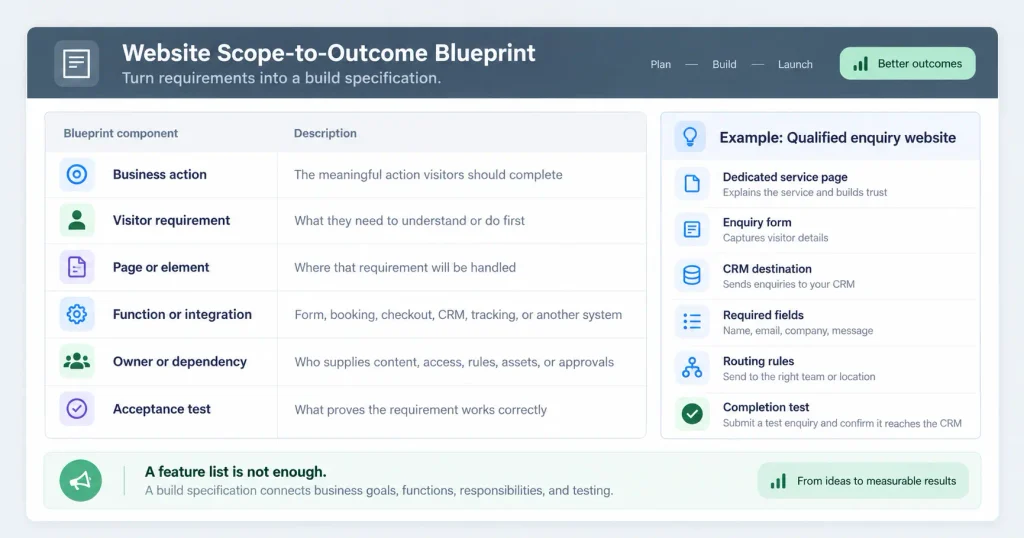
A useful website scope should describe more than the number of pages being designed. It should connect each important business requirement with the website element, functionality, responsibility, and test needed to deliver it.
A simple Website Scope-to-Outcome Blueprint can make that clearer:
| Requirement | What to Define |
| Business action | The meaningful action visitors should complete |
| Visitor requirement | What they need to understand or do first |
| Page or element | Where that requirement will be handled |
| Function or integration | Form, booking, checkout, CRM, tracking, or another system |
| Owner or dependency | Who supplies content, access, rules, assets, or approvals |
| Acceptance test | What proves the requirement works correctly |
Consider a service business that wants qualified enquiries. The website might need a dedicated service page and enquiry form, but that alone is not a complete requirement.
The scope should also clarify where the submission goes, whether it enters a CRM, which fields are required, who provides the routing rules, and how the completed form will be tested.
The same reasoning applies to ecommerce, online booking, memberships, quote requests, downloads, or other website functions.
This gives a business something more useful than a feature list. It creates a specification that can be compared with what the freelancer is actually proposing to deliver.
Separate Core Website Scope From Project Dependencies
Website projects often become unclear when responsibilities are assumed rather than assigned.
Pages, responsive layouts, agreed forms, standard integrations, and functional testing may belong inside the website build when they are included in the proposal. Other requirements may depend on separate work or information that the business must provide.
Examples include:
- final website copy
- original photography
- brand assets
- complex CRM automation
- ongoing SEO
- ongoing conversion optimization
- advanced analytics
- legal or privacy review
- continued maintenance
The distinction matters because a designer cannot correctly configure a booking process without booking rules, connect a CRM without appropriate access, or finalize a service page without approved content.
California-specific requirements should also be treated conditionally. For example, whether the California Consumer Privacy Act applies depends on the business and the current legal criteria that govern coverage. A website serving California customers should not automatically be treated as subject to every CCPA requirement solely because customers are located in the state.
If you need broader guidance on evaluating portfolios, proposals, ownership, and provider fit, the website designer selection guide covers those questions in more depth.
Define What “Done” Means Before Design Approval and Launch
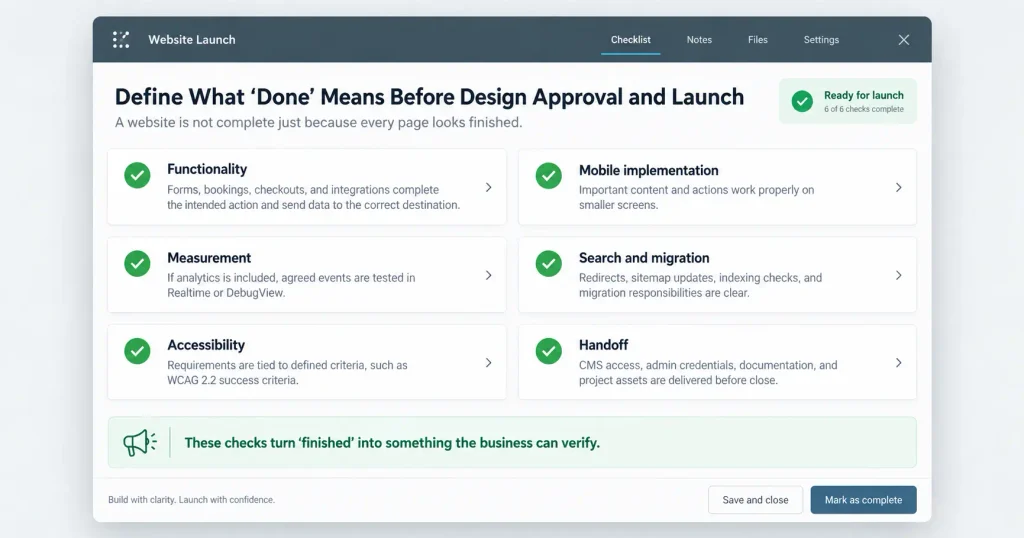
A website should not be considered complete simply because every page looks finished.
The project should have agreed acceptance checks for the requirements that are actually included in scope.
For example:
- Functionality: Forms, bookings, checkouts, and agreed integrations should complete the intended action and send information to the correct destination.
- Mobile implementation: Important content and actions should work properly on smaller screens. Google uses the mobile version of website content for mobile-first indexing and recommends responsive design.
- Measurement: If analytics is included, agreed events should be tested. Google Analytics provides tools such as Realtime and DebugView for checking whether events are being received.
- Search and migration: When a redesign changes URLs, responsibilities for redirects, sitemap updates, indexing checks, and migration issues should be explicit. Google’s site-migration guidance specifically warns about incorrect redirects and accidental indexing blocks.
- Accessibility: If accessibility requirements are included, they should be tied to defined criteria. WCAG 2.2 provides testable accessibility success criteria rather than relying on a vague claim that a site is “accessible.”
- Handoff: Agreed CMS access, administrator credentials, documentation, or other project assets should be delivered before the project is closed.
These checks turn “finished” into something the business can verify.
For a deeper look at page-level conversion issues such as visitor intent, confidence, friction, and forms, see the website conversion guide.
Use the Scope to Decide Whether the Freelancer Fits the Project
Once the website requirements are clear, the freelancer can be evaluated against the actual project rather than a generic list of credentials.
The important questions become more specific:
- Can one professional realistically deliver the required pages and functionality?
- Are included and excluded responsibilities clear?
- Have important dependencies been identified?
- Can the freelancer explain how critical functions will be tested?
- Does the proposal reflect the real website requirements instead of forcing the business into a generic package?
A Website Design Freelancer California option does not need to be judged primarily by physical proximity. For many website projects, the stronger test is whether the scope, implementation responsibilities, and definition of done match what the business actually needs.
For broader hiring due diligence around agreements, access, deliverables, and ownership, use the digital marketing freelancer hiring checklist.
If you are planning a new website or redesign, you can share your current site, the main action you want visitors to take, required pages, functionality, integrations, and any known constraints with Hey Pawan. Pawan Kumar works as one independent digital marketing professional with 10+ years of experience and can review whether the required website scope is a practical fit for direct support.
Frequently Asked Questions
Does a website design freelancer need to be located in California?
No. Physical location can matter when a project requires in-person photography, meetings, or other on-site work, but most website planning, design, development, integrations, and testing can be handled remotely. Evaluate whether the freelancer can deliver the required scope rather than assuming location alone determines project fit.
How much does a Website Design Freelancer California project cost?
There is no single reliable statewide price that fits every website project. Cost can change with page count, platform, ecommerce requirements, custom functionality, integrations, migration needs, content readiness, and ongoing support. Compare what each proposal actually includes rather than comparing the total price alone.
How long does a freelance website-design project take?
The timeline depends on the website’s scope, content readiness, approval process, functionality, integrations, platform, and whether an existing website must be migrated. A useful schedule should therefore be based on defined requirements and dependencies instead of a universal website-design timeline.
Can a freelancer redesign an existing WordPress, Shopify, Wix, or other website?
Often, yes. The right approach depends on the existing platform, access, theme or template restrictions, plugins or apps, custom code, content, data, and the scale of the required changes. Some projects need targeted redesign work, while others may require rebuilding or migration.
Is SEO normally included in website design?
Some search-related foundations may be included, such as crawlable navigation, URL planning, metadata implementation, redirects, and mobile usability. Ongoing keyword strategy, content development, technical SEO programs, and link acquisition are usually separate decisions. Google’s Search Central documentation treats search-friendly development as a specific technical responsibility.
Who handles website maintenance after launch?
Maintenance should be agreed before the project ends. It may be handled by the original freelancer, another provider, or the business internally. Clarify responsibility for software updates, backups, security, licenses, content changes, technical support, and other ongoing work instead of assuming the initial build includes continuing maintenance.
Sources
- Google Analytics
About key events
https://support.google.com/analytics/answer/9267568 - Google Analytics
[GA4] Report on key events
https://support.google.com/analytics/answer/12571843 - Google Search Central
SEO Guide for Web Developers
https://developers.google.com/search/docs/fundamentals/get-started-developers - Google Search Central
Mobile-first indexing best practices
https://developers.google.com/search/docs/crawling-indexing/mobile/mobile-sites-mobile-first-indexing - Google Search Central
Site moves and migrations with URL changes
https://developers.google.com/search/docs/crawling-indexing/site-move-with-url-changes - World Wide Web Consortium (W3C)
Web Content Accessibility Guidelines (WCAG) 2.2
https://www.w3.org/TR/WCAG22/ - California Privacy Protection Agency
Frequently Asked Questions: California Consumer Privacy Act
https://cppa.ca.gov/faq