Business owners and marketing managers often hire outside support because SEO, paid advertising, website performance, content, or tracking has become difficult to manage internally. The challenge is determining whether a digital marketing freelancer has the right experience, process, capacity, and accountability for the actual business problem.
A strong hiring decision should not begin with hourly rates or the longest service list. It should begin with a clear problem, a defined first phase, relevant evidence, realistic success measures, and an agreement about who owns the accounts, data, and completed work.
A business should hire a digital marketing freelancer only after defining the problem, required channels, expected deliverables, internal responsibilities, and success measures. Evaluate candidates through relevant evidence, strategic reasoning, platform experience, communication, reporting, account-access practices, availability, and realistic expectations. The right choice depends on whether one specialist can responsibly manage the required scope.
What Does a Digital Marketing Freelancer Do?
A digital marketing freelancer is an independent professional who plans, audits, implements, or manages specific marketing activities for a business. The scope may focus on one discipline, such as SEO, or combine connected areas such as paid advertising, websites, content, analytics, and conversion tracking.
Freelance status describes the working arrangement, not the person’s level of expertise. One freelancer may specialize in technical SEO, while another may work across Google Ads, landing pages, tracking, and conversion optimization.
Before hiring anyone, clarify three responsibilities:
- Who will develop the strategy?
- Who will complete the implementation?
- Who will measure and report the results?
A freelance digital marketing expert should be able to explain which parts of the project they personally handle, which tasks require client support, and which activities fall outside the agreed scope.
A digital strategy consultant may help diagnose problems and prioritize work across several channels. A task-focused freelancer may instead be hired to execute a clearly defined activity. Neither model is automatically better, but the distinction should be clear before work begins.
Define the Business Problem Before Comparing Freelancers
Before comparing candidates, define the business problem, available evidence, desired outcome, timeline, and internal resources. A clear problem statement makes it easier to determine whether you need SEO, advertising, website improvements, analytics, content, or several connected services.
A vague request might be:
We need help with digital marketing.
A more useful request would be:
Our service pages receive traffic, but form submissions are low. We also cannot identify which channels generate qualified enquiries because our conversion tracking is incomplete.
Another example might be:
Google Ads is spending consistently, but lead quality is poor, and we do not know whether the problem is targeting, search terms, landing pages, or tracking.
Before contacting a freelancer, document:
- The main business problem
- The product or service being promoted
- The intended customer and target market
- The current website and marketing platforms
- The primary conversion action
- The available data
- The budget range
- The desired timeline
- The internal decision-maker
- Any existing providers or technical limitations
In my experience, projects become easier to scope when the business separates the actual problem from its preferred solution. A company may ask for more traffic when the more urgent issue is weak conversion tracking, unclear messaging, or poor lead qualification.
My process at Hey Pawan follows the same principle: review the business context, prioritize the work supported by evidence, implement the agreed scope, and measure what should happen next.
Which Skills Does Your Project Actually Require?
The required skills should be selected according to the problem, not the freelancer’s job title. A digital marketing expert may understand several disciplines, but that does not mean every service should be included in one engagement.
| Business problem | Skills that may be required |
| Important pages are not visible in search | Technical SEO, on-page SEO, content, internal linking |
| Paid traffic is expensive or irrelevant | PPC strategy, keyword analysis, targeting, negative keywords |
| Website traffic does not become enquiries | Conversion optimization, UX, messaging, analytics |
| Marketing data is incomplete or conflicting | GA4, Google Tag Manager, platform integrations |
| Website is slow or difficult to manage | Website development, performance, technical SEO |
| Marketing channels are disconnected | Digital strategy, analytics, prioritization |
Businesses dealing with organic visibility, technical access, weak service pages, or AI-search understanding may need SEO and AI search support. Companies experiencing irrelevant ad clicks, unreliable conversion data, or weak landing-page alignment may instead need PPC and paid advertising management.
This table is a starting point, not a diagnosis. Low lead volume might result from weak targeting, limited demand, an unclear offer, poor mobile usability, broken tracking, or slow sales follow-up.
A capable digital marketing strategy consultant should investigate those possibilities before prescribing more content, a larger advertising budget, or a complete website redesign. Where usability, page structure, trust, and conversion paths are central to the problem, conversion-focused website design may also be relevant.
How Should You Evaluate Experience and Evidence?
Evaluate a freelancer’s experience according to the similarity of the problem, the candidate’s exact role, the work completed, and the evidence available to support it.
A polished portfolio image may demonstrate design ability, but it does not prove that the person developed the strategy, configured tracking, managed a campaign, or interpreted the results.
When reviewing previous work, ask:
- What problem was the client trying to solve?
- Which tasks did the freelancer personally complete?
- What tools and platforms were involved?
- What constraints affected the project?
- How was performance measured?
- Can the work or outcome be verified?
- Is the example relevant to your business problem?
- Is the example recent enough to reflect current practices?
Google recommends asking an SEO provider about previous work, expected results, timeframes, measurement, communication, and relevant industry or geographic experience. It also advises businesses to understand the reasoning behind proposed changes.
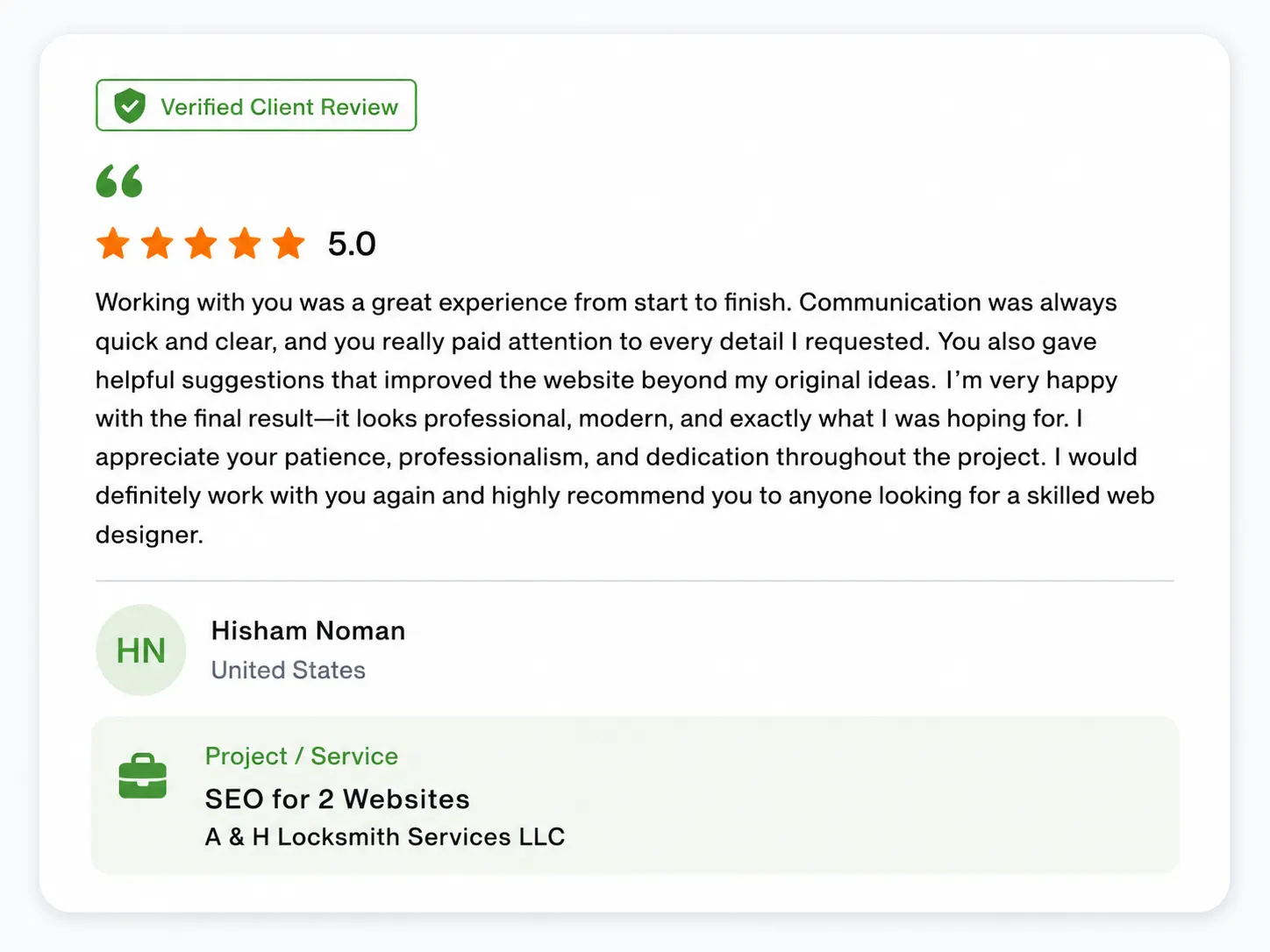
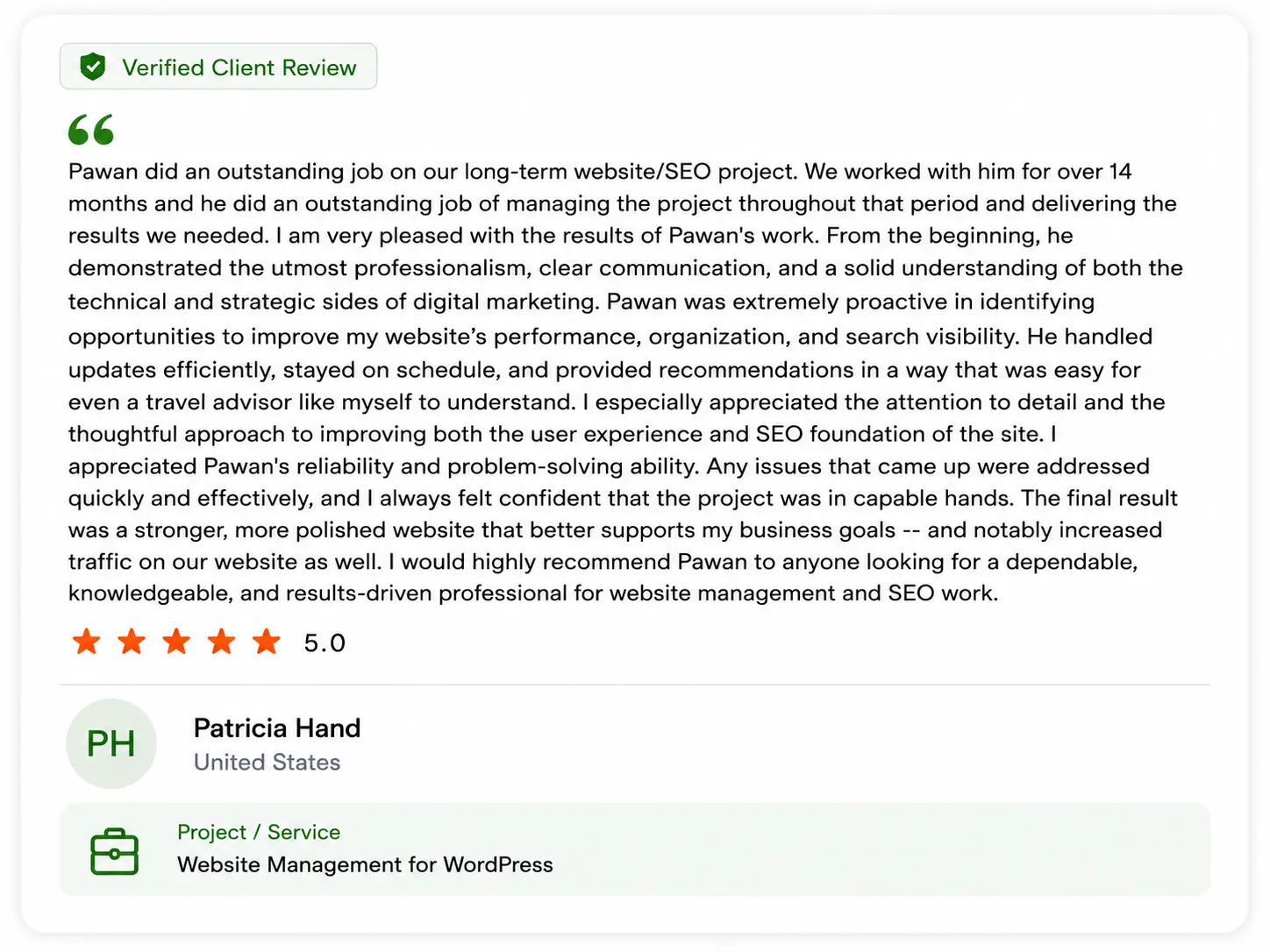
Case studies, reviews, certifications, and platform history can all support credibility, but they answer different questions. A review may demonstrate communication and reliability. A case study may show problem-solving. A certification may confirm knowledge of a platform. None guarantees the same result for another business.
Prospective clients evaluating Pawan’s experience can review documented digital marketing case studies showing the work completed and the available supporting evidence.
What Questions Should You Ask a Digital Marketing Freelancer?
Ask questions that reveal how the freelancer diagnoses problems, chooses priorities, measures outcomes, manages access, and recognizes limitations. Strong candidates should be able to explain their reasoning without hiding behind jargon or guarantees.
Useful questions include:
- How would you investigate this problem before recommending work?
- Which parts of the project would you personally complete?
- Which previous project is most relevant to this scope?
- What information and platform access would you need?
- How would you define and measure success?
- Which metrics would you report, and why?
- What factors could prevent the project from succeeding?
- What is outside your current capability or capacity?
- How do you handle requests outside the agreed scope?
- Who will own the accounts, data, website files, and creative assets?
- How often will priorities and performance be reviewed?
- What would the first phase include?
- How would the project be handed over if the engagement ended?
The quality of the explanation matters more than the speed of the answer. A credible freelancer may say that more information is needed before making a recommendation. That is often a better sign than receiving an immediate package, timeline, and performance promise before the website or data has been reviewed.
Who Should Own Your Website, Advertising, and Analytics Accounts?
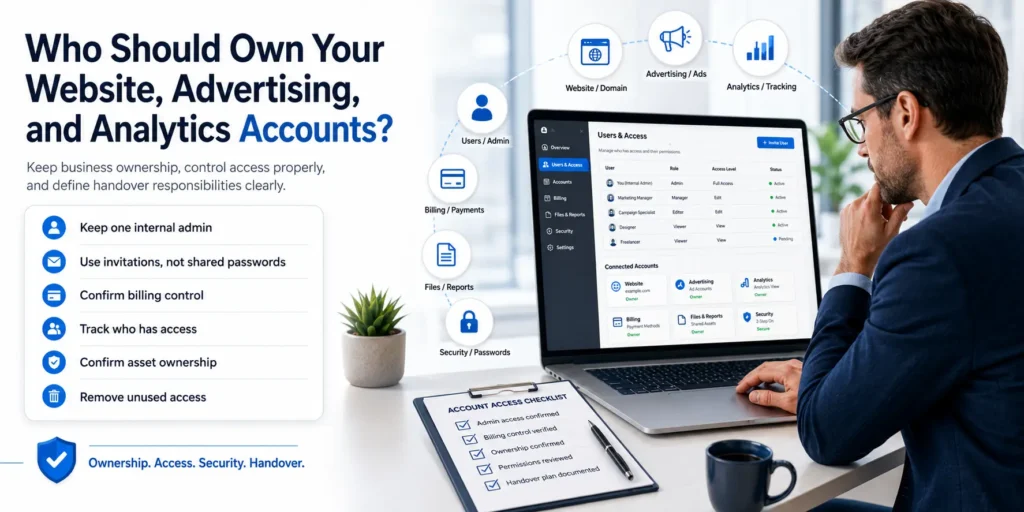
The business should retain appropriate ownership and administrative control of its domain, website, advertising accounts, analytics properties, tag-management account, merchant profiles, and other essential digital assets.
A freelancer should normally receive the access required to complete the work rather than becoming the only person who controls an account.
Google Ads allows administrators to invite users, assign access levels, edit permissions, and remove access. A client account can also unlink a manager, including a manager with ownership, although the exact permissions depend on the account relationship.
Google Analytics provides role-based access and data restrictions at the account and property levels.
Before work begins:
- Keep at least one internal administrator.
- Use platform invitations instead of routinely sharing passwords.
- Confirm who controls billing.
- Record which accounts exist and who can access them.
- Confirm ownership of website files, copy, creative assets, and reports.
- Remove unnecessary access when the engagement ends.
- Avoid creating critical accounts solely under the freelancer’s personal email.
Access requirements vary by platform and task, but ownership and handover responsibilities should never remain unclear.
How Should Results and Reporting Be Defined?
Success should be defined through business outcomes, relevant marketing signals, and the limitations of the available data. Reports should explain what changed, what happened, what the data suggests, and what action should be taken next.
Separate four types of measurement:
- Business outcomes: qualified enquiries, purchases, appointments, or revenue
- Conversion actions: forms, calls, bookings, checkouts, or downloads
- Leading indicators: impressions, rankings, clicks, engagement, or traffic
- Diagnostic metrics: search terms, crawl errors, landing-page performance, or tracking failures
A recorded conversion is not automatically a qualified lead. An increase in website traffic is not automatically business growth. Different platforms may also attribute the same customer journey differently.
I usually review tracking accuracy before drawing strong conclusions about campaign or website performance. Incorrect event setup, duplicate conversions, missing call tracking, or internal traffic can distort the apparent results.
Performance expectations should remain realistic because rankings, lead quality, revenue, and return on ad spend depend on the market, offer, competition, budget, website, tracking, and sales process.
What Are the Warning Signs of a Poor-Fit Freelancer?
Warning signs include guaranteed outcomes, vague deliverables, irrelevant evidence, unclear account ownership, and an unwillingness to explain decisions or limitations.
Look more carefully when a candidate:
- Guarantees rankings, leads, sales, or revenue
- Claims to use a secret or Google-approved method
- Recommends work without understanding the business
- Uses the same package for every project
- Cannot define deliverables or exclusions
- Reports only impressions, clicks, or rankings
- Wants sole control of important accounts
- Cannot explain their role in previous projects
- Avoids discussing capacity or availability
- Has no process for changes in scope
- Will not explain how the work will be handed over
- Makes claims that conflict with official platform guidance
Google advises businesses to compare third-party SEO advice with official documentation. It also states that Google does not approve third-party SEO tools or services and that no provider can guarantee ranking performance.
One weak answer may require clarification. Several combined warning signs usually indicate poor scope control, weak accountability, or increased business risk.
Should You Hire a Freelancer, Agency, or In-House Marketer?
A freelancer often suits a defined project, a specialist gap, or a connected scope that one experienced professional can manage. An agency may suit projects requiring several specialists at the same time. An in-house hire may be appropriate when the work requires daily availability and deep integration with internal operations.
| Factor | Freelancer | Agency | In-house marketer |
| Communication | Usually direct | May include an account layer | Direct internal access |
| Capacity | Limited to one person | Potentially broader | Dedicated but role-specific |
| Specialist depth | Depends on the individual | Depends on assigned staff | Depends on the employee |
| Best use | Defined projects or specialist support | Multi-person delivery | Continuous internal work |
| Management need | Moderate | Moderate | High |
| Continuity | Depends on availability | Depends on staffing | Strong while employed |
A freelancer may be a good fit when:
- The problem is reasonably defined.
- One professional can cover the required scope.
- Direct communication is valuable.
- The business can provide timely access and approvals.
An agency may be a better fit when several specialists must deliver substantial work simultaneously or when backup capacity is essential.
An in-house hire may be appropriate when the workload is continuous, business knowledge must be developed internally, and the organization can support recruitment, management, software, and employment costs.
A Practical Digital Marketing Freelancer Hiring Scenario
Consider a service business that says:
We need more leads from SEO and Google Ads.
Instead of immediately increasing ad spend or publishing more content, the first project phase could include:
- Reviewing current service pages and organic visibility
- Auditing Google Ads search terms and targeting
- Verifying form, call, and GA4 conversion tracking
- Evaluating landing-page messaging and mobile usability
- Identifying whether poor results come from traffic, targeting, tracking, conversion, or offer clarity
- Delivering prioritized recommendations
- Implementing only the approved first-phase changes
- Reviewing qualified enquiries after an agreed data period
This creates a testable scope. Responsibilities are visible, required access is known, and SEO, PPC, website, and analytics dependencies are evaluated together.
The purpose of the first phase is not to solve every marketing problem immediately. It is to replace assumptions with enough evidence to choose the right next action.
What Should Be Confirmed Before Signing an Agreement?
Before work begins, confirm the objective, deliverables, exclusions, access, ownership, schedule, reporting, fees, communication, and offboarding arrangements.
Use this final checklist:
- The business problem is documented.
- The first project phase is defined.
- Deliverables and exclusions are listed.
- Required access is confirmed.
- Account and asset responsibilities are clear.
- An internal decision-maker is identified.
- Success measures are documented.
- Reporting frequency is agreed.
- Fees and billing terms are understood.
- Scope changes require approval.
- Confidential information will be handled appropriately.
- Response and availability expectations are realistic.
- Cancellation and handover terms are understood.
The goal is not to remove every uncertainty. It is to make responsibilities, decisions, and risks visible before work starts.
Need Help Defining Your Digital Marketing Scope?
Hey Pawan is the professional brand of Pawan Kumar, an independent digital marketing freelancer who works directly with businesses on clearly scoped marketing and website problems.
Share your website, target market, current challenge, and the outcome you want to improve. I will review the context personally and explain whether the project fits my experience and what a practical first step may involve.
Discuss your project with Hey Pawan.
Frequently Asked Questions
How much does it cost to hire a digital marketing freelancer?
The cost depends on the service, project complexity, required platforms, current website condition, available data, implementation responsibility, and whether the work is fixed-scope or ongoing. Compare proposals by deliverables, responsibilities, measurement, and relevant experience rather than selecting only the lowest hourly rate.
How long does a digital marketing freelancer project take?
The timeframe depends on the problem and scope. A focused audit may be completed faster than a website redesign, SEO campaign, tracking rebuild, or ongoing advertising engagement. The freelancer should explain the first phase, dependencies, approval requirements, and when enough data may be available to evaluate progress.
How should a freelancer measure digital marketing performance?
Measurement should connect marketing activity with meaningful actions such as qualified forms, calls, purchases, bookings, or revenue where reliable data is available. Reports should also include leading and diagnostic indicators, explain data limitations, and identify which action should be taken next.
Can one freelancer implement SEO, PPC, website, and analytics work?
Some experienced freelancers can manage several connected disciplines, but the scope must remain realistic. Confirm which tasks the freelancer personally performs, which platforms they understand, how much work is required simultaneously, and when another specialist may be needed. One person still has finite capacity.
How do I know whether I need professional digital marketing help?
Professional help may be useful when the problem requires specialist knowledge, reliable tracking, technical implementation, campaign management, or coordination across multiple channels. Before hiring, define the business issue, review what has already been attempted, and determine whether internal staff have the time and expertise to complete the work accurately and consistently.