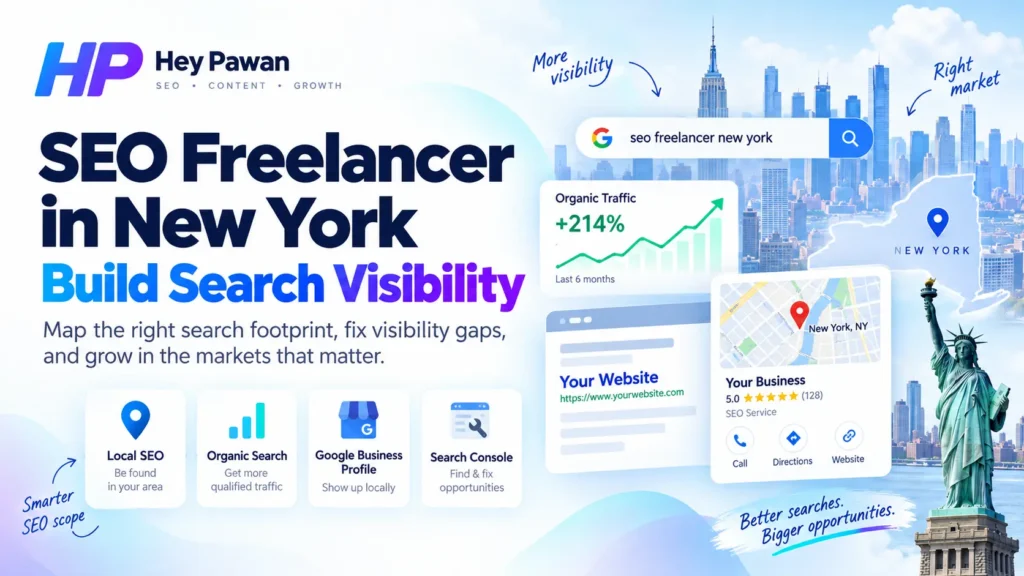
Hiring an SEO Freelancer in New York should start with a clearer question than “How do we rank higher?” The real issue is where your customers search, what they search for, which part of Google should show your business, and which page or profile should earn that visibility.
A local service business in Manhattan, a company serving several New York markets, and a SaaS company headquartered in New York can require very different SEO strategies. Defining that search footprint first helps you avoid paying for work that does not address the real visibility problem.
What Does Search Visibility in New York Actually Mean?
Search visibility means having the right business asset appear for searches made by the customers you actually want to reach.
That asset might be:
- a service page in standard organic results;
- a Google Business Profile in Maps or local results;
- a category or product page;
- a useful informational article;
- the homepage for an appropriate branded or broad commercial search.
This distinction matters because “ranking in New York” is too broad to be a useful objective.
A business serving customers near one physical location may care heavily about Google Maps and nearby searches. A B2B company selling throughout the United States may care much more about non-local organic queries, even if its headquarters happens to be in New York.
Google explains that local results are primarily influenced by relevance, distance, and prominence. This means genuine local visibility involves real geographic relationships, not simply adding “New York” to page titles and headings. Google guidance on local ranking
SEO Freelancer in New York: Map the Search Footprint First
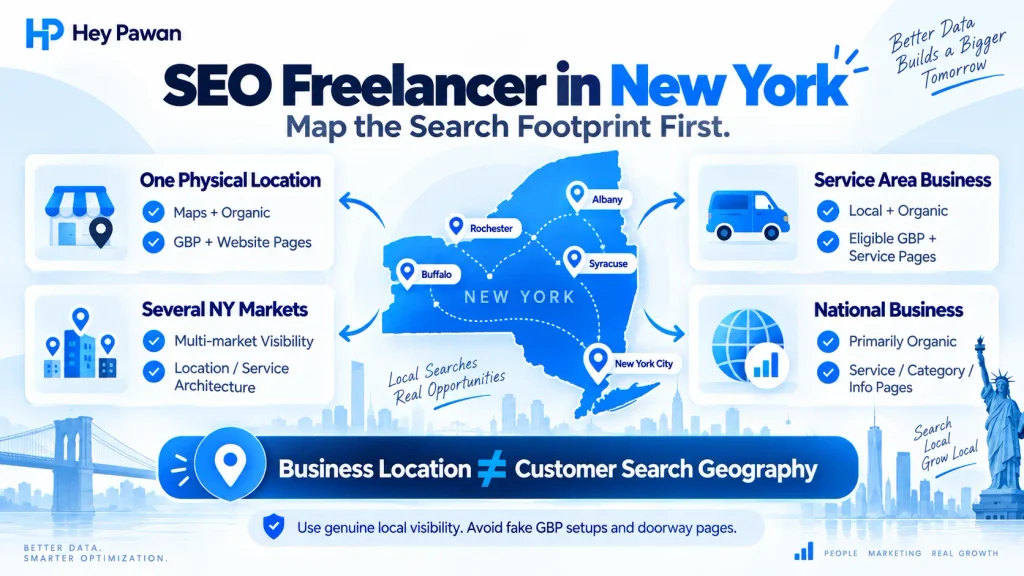
Before an SEO freelancer recommends pages, backlinks, Local SEO work, or technical fixes, define the geographic search footprint the business genuinely needs.
A useful starting point is to determine which situation best describes the business:
| Customer search situation | Likely search surface | Asset that may need visibility |
| Customers visit one physical location | Maps/local results and organic search | Google Business Profile plus relevant website pages |
| Business travels to customers in a genuine service area | Local and organic results | Eligible Business Profile plus service pages |
| Business serves several real New York markets | Organic and potentially local results | Appropriate location/service architecture |
| Business serves customers nationally | Primarily organic search | Service, category, product, and informational pages |
The important point is that business location and customer search geography are not automatically the same thing.
Google Business Profiles generally require genuine in-person customer contact, either at an eligible customer-facing location or because the business travels to customers. Online-only businesses should not create a New York profile simply to obtain local visibility. Google Business Profile eligibility guidelines
Location pages also need a genuine purpose. Creating nearly identical Manhattan, Brooklyn, Queens, Bronx, Buffalo, Albany, or other city pages simply by replacing place names can create poor user experiences and may cross into the kind of regional doorway content Google warns against. Google Search spam policies
Match Each Search Opportunity to the Right Search Surface and Asset
Once geography is clear, match each important search intent to the asset that should satisfy it.
A person looking for a nearby service may need to find a legitimate local listing and relevant service page. Someone comparing a specialized B2B service may be better served by a detailed commercial page in standard organic results. A research-oriented search may require an informational resource instead.
The practical question is:
Which asset should appear for this search?
That is more useful than simply asking whether the business “needs more content.”
For each important opportunity, identify:
- what the customer is trying to accomplish;
- where that result is likely to appear;
- which existing page or profile should satisfy the intent;
- whether that asset is actually suitable for the job.
AI Overviews and AI Mode can also be considered search surfaces, but they do not require abandoning normal SEO fundamentals. Google states that established SEO best practices continue to apply and that there are no additional technical requirements specifically for appearing in these AI experiences. Google guidance on AI features and websites
Find the Coverage Gap Before You Approve the SEO Work
Once the correct asset is identified, determine what is preventing it from providing the visibility you need.
Most problems fit into one of five useful states.
Absent: There is no suitable page or eligible profile for the search opportunity.
Ineligible or inaccessible: The asset exists, but eligibility, crawling, indexing, rendering, canonicalization, or another technical issue may prevent it from appearing appropriately.
Misaligned: The page exists and can appear in search, but its intent, topic, or geographic focus does not match what customers are searching for.
Under-supported: The right asset exists, but it may need stronger content, internal linking, local signals, prominence, authority, or other supporting work.
Unverified: Work has been completed, but nobody has established how improvement will actually be measured.
This prevents a common mistake: approving an SEO activity before diagnosing the visibility problem.
A business should not automatically buy backlinks when the correct page does not exist. It should not keep publishing articles when an important page cannot be indexed correctly. It should not invest heavily in Google Business Profile work if the business is not eligible for a profile.
Turn the Visibility Gap Into the Right Freelance SEO Scope
A strong SEO Freelancer in New York proposal should connect each major task to a defined search visibility problem.
A simple translation looks like this:
| Visibility gap | Work that may be appropriate |
| No suitable page exists | Content creation or site architecture |
| Important page cannot reliably appear | Technical SEO |
| Page targets the wrong intent | On-page SEO or content revision |
| Eligible local business lacks local visibility | Google Business Profile and Local SEO |
| Correct page lacks support | Internal linking, content depth, authority development |
| Progress cannot be evaluated | Search Console or Business Profile measurement setup |
Not every business needs all of these at once.
This is why a long deliverables list does not automatically make an SEO proposal stronger. Google recommends understanding an SEO provider’s methods, expected results, measurement approach, and recommendations before hiring. Google guidance on hiring an SEO
For every substantial activity in a proposal, ask:
Which visibility problem is this work intended to solve?
If there is no clear answer, the scope may need refinement.
Verify Whether Search Visibility Is Improving Where It Matters
SEO progress should be verified using evidence that matches the search surface being targeted.
For standard organic visibility, Google Search Console can help evaluate:
- relevant search queries;
- pages receiving impressions;
- clicks;
- click-through rate;
- general position trends;
- country-level performance.
One limitation matters for a New York-focused campaign. The standard Search Console Performance report provides a country dimension rather than a native New York state or New York City geographic dimension. US impressions should therefore not automatically be described as “New York visibility.” Google Search Console performance filtering guidance
For verified Business Profiles, Google Business Profile Performance can provide additional evidence such as search terms, profile views, calls, direction requests, website clicks, and other applicable interactions. Google Business Profile Performance guidance
These metrics do not mean every ranking or customer outcome can be attributed perfectly. They do provide stronger evidence than relying only on an SEO tool score or a handful of manually checked keywords.
If you are trying to determine why your website is visible for some searches but missing from the New York markets that matter, you can share your website, main services, actual customer locations, and available Search Console or Business Profile data with me. I can review the visibility gaps directly and help define the SEO work that deserves priority.
Frequently Asked Questions
Does an SEO freelancer need to live in New York to work on New York SEO?
No. Physical proximity is not automatically required for SEO delivery. What matters is whether the freelancer correctly understands the target market, search intent, geographic constraints, implementation requirements, and measurement.
Is SEO for New York City the same as SEO for New York State?
No. New York City searches can involve different local intent, competitors, geographic relationships, and landing-page requirements than searches targeting another part of New York State or a broader statewide market.