Hiring a Digital Marketing Freelancer in New York should not begin with a list of services. It should begin with two more useful questions: Which customers are you actually trying to reach, and what is currently preventing your marketing from producing the result you need?
A business based in New York may serve one neighborhood, several boroughs, the entire state, or customers across the country. Likewise, weak results might come from limited search visibility, ineffective paid campaigns, poor website conversion, or unreliable tracking. Defining those two things first makes it much easier to decide what a freelancer should actually work on.
Before Hiring a Digital Marketing Freelancer in New York, Define the Market
Start by separating four different locations:
- Where your business is based;
- Where your customers are located;
- Where your marketing is targeting;
- Where the freelancer is physically located.
They do not have to be the same.
For example, New York City consists of five boroughs, while New York State covers a much wider geographic area. New York City government overview New York State counties
Before deciding that you need “New York marketing,” ask:
- Where can customers realistically buy from you?
- Which areas can your business actually serve?
- Are you targeting one borough, New York City, selected parts of the state, the whole state, or customers nationally?
- Does customer location materially change how people search for or buy your service?
- Do your existing customers and marketing data support that geographic focus?
This matters because marketing geography can be configured much more precisely than simply choosing “New York.” Google Ads supports geographic targeting across countries, areas within countries, cities or postal areas where supported, and radius-based locations. Google Ads geographic targeting documentation
Your starting point should therefore be the customer market, not automatically the business address or the freelancer’s location.
Identify the Marketing Bottleneck Before Choosing a Service
Once the market is clear, identify the strongest current constraint.
A common mistake is jumping straight from a symptom to a service. Low leads do not automatically mean you need SEO. Weak advertising results do not automatically mean you need a larger ad budget.
Instead, classify the problem.
| What you are seeing | What may need investigation |
| Relevant customers rarely find the business in search | SEO or local search visibility |
| Ads generate traffic but useful leads are weak or unclear | Paid advertising, targeting, landing pages, or tracking |
| Relevant traffic reaches the site but few visitors enquire or buy | Website conversion and user journey |
| You cannot tell which channels generate meaningful actions | Analytics and conversion tracking |
| Several channels appear disconnected | Cross-channel diagnosis before deeper execution |
The important word here is investigation. A symptom is evidence that something deserves attention, not proof of the final diagnosis.
Measurement should also focus on actions that matter to the business. Google Analytics uses key events for actions considered important to the business, while Google Ads conversion measurement can track valuable actions such as purchases, sign-ups, or calls. Google Analytics key events documentation Google Ads conversion measurement documentation
How a Digital Marketing Freelancer in New York Should Prioritize the First Workstream
The first workstream should address the strongest verified constraint within the customer market, while leaving unrelated activities outside the initial scope.
A simple decision map can help:
| Market and problem | Evidence to inspect | Possible first workstream |
| Local target market has weak relevant search visibility | Search Console, Google Business Profile, search presence | SEO or local search diagnosis |
| Paid campaigns run but lead quality is uncertain | Google Ads, conversions, lead feedback, landing pages | PPC and conversion review |
| Relevant traffic exists but enquiries remain weak | GA4, landing pages, forms, user journey | CRO or website review |
| Marketing reports cannot be trusted | GA4, GTM, ad-platform tracking | Measurement validation |
| Geography and several channels are both unclear | Cross-channel accounts and business data | Diagnostic first phase |
Geography should be part of this diagnosis. Google Ads provides geographic performance information that can help a business determine whether certain areas deserve more focus, less focus, or different targeting. Google Ads location optimization guidance
For businesses dependent on local discovery, geography can also influence organic visibility. Google says local results are mainly based on relevance, distance, and how prominent or well known a business is. Google local ranking guidance
The goal is not to activate every marketing channel. It is to identify the first area where better evidence or execution can improve the next business decision.
Decide Whether the Work Needs Broad Support or a Specialist
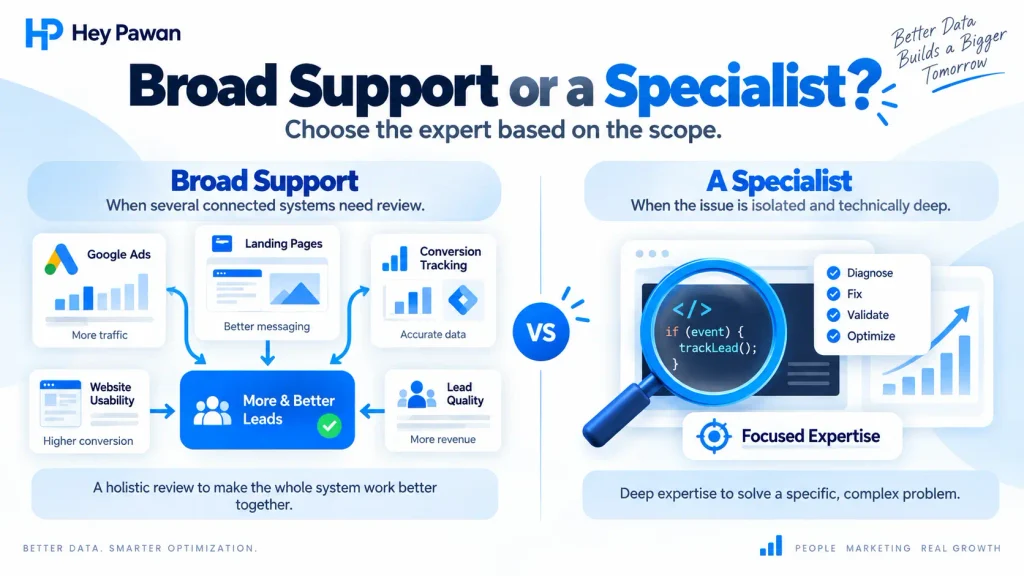
Broad freelance support can make sense when several connected systems need to be reviewed together.
For example, weak lead generation may involve Google Ads targeting, landing-page messaging, conversion tracking, and website usability at the same time. In that situation, someone who can evaluate the connected journey may be more useful initially than immediately dividing the project among several specialists.
A deeper specialist may be more appropriate when the issue is already clearly isolated, technically advanced, or large enough to require concentrated expertise in one discipline.
The decision should therefore follow the scope, not the number of services shown on a freelancer’s profile.
For broader provider due diligence after the scope is defined, use the Hey Pawan guide to hiring a digital marketing freelancer.
Build a Useful Brief Before the First Conversation
A good starting brief does not need to be long. It needs to make the problem understandable.
Include five things:
1. Market
State where the customers you want to reach are located.
2. Problem
Describe the observable issue instead of prescribing the solution.
Rather than saying:
We need SEO and Google Ads.
A more useful starting point is:
We receive website traffic, but qualified enquiries from our target New York market are limited.
3. Evidence
List what is already available, such as:
- website;
- Google Analytics 4;
- Google Search Console;
- Google Ads;
- CRM information;
- form submissions;
- call or sales data.
4. First desired outcome
Explain what the first phase should clarify.
For example:
Determine whether our main problem is paid targeting, conversion tracking, or the landing page.
5. Constraints
Mention important limits involving timing, budget, existing platforms, access, internal resources, or requirements for in-person work.
This gives a freelancer enough information to define the first scope without turning the initial conversation into a vague request for “more marketing.”
Use the First Phase to Make the Next Marketing Decision Clearer
The first phase does not need to solve every marketing issue. It should produce enough evidence to make the next priority clearer.
At the end of that phase, you should be able to answer:
- What did we learn about the original problem?
- Is the initial diagnosis still valid?
- Should the target geography change?
- Does the current workstream deserve further investment?
- Is another dependency blocking results?
- Is deeper specialist support now required?
- Which activities should remain outside scope?
This prevents a digital marketing engagement from becoming an endless collection of unrelated tasks.
If you are considering a Digital Marketing Freelancer in New York, you can share your website, target customer geography, current marketing problem, active channels, and desired outcome with Hey Pawan. Pawan Kumar works as one independent digital marketing professional with 10+ years of experience across SEO, paid advertising, website work, CRO, analytics, and related digital marketing services. The first step is to determine whether your problem fits a clear remote freelance scope.
Explore Hey Pawan digital marketing services
Frequently Asked Questions
Does a digital marketing freelancer need to live in New York?
Not necessarily. Physical location matters most when the agreed work genuinely requires regular in-person access or production. SEO, paid advertising, analytics, CRO, and much website work can often be handled remotely when the freelancer has the necessary access and business context.
What if my business is in New York but serves customers nationwide?
Your business address does not automatically need to define the marketing boundary. If customers can buy from you nationwide, evaluate which geographic markets actually matter to acquisition and build targeting, landing pages, and measurement around those markets rather than forcing a New York-only strategy.
Is Google Ads location targeting completely precise?
No. Google states that location targeting uses several signals, including settings, devices, and user behavior, and that 100% accuracy is not guaranteed. Geographic targeting should therefore be checked against actual location-performance data instead of being treated as perfectly precise. Google Ads location targeting guidance
Sources
- New York City Government: Understanding Local Government in NYC
- State of New York: Counties
- Google Ads Help: Target Ads to Geographic Locations
- Google Ads Help: Refine Your Location Targeting
- Google Analytics Help: About Key Events
- Google Ads Help: About Conversion Measurement
- Google Business Profile Help: Improve Your Local Ranking
- Google Ads Help: Location Targeting Accuracy
- Hey Pawan: Digital Marketing Freelancer Hiring Checklist