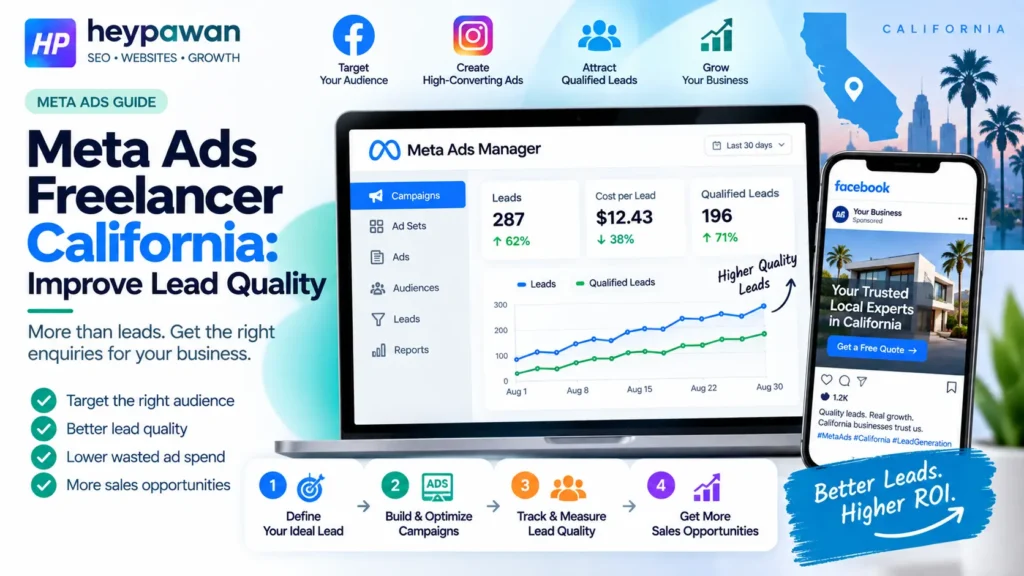
Getting more Meta leads is not always the same as getting more useful sales opportunities. Before asking a Meta Ads Freelancer California specialist to improve performance, a business needs to define what a qualified lead actually looks like.
That definition should guide targeting, messaging, qualification, tracking, and optimization. A capable freelancer should be able to connect your business rules to the signals Meta receives, separate geographic mismatches from other lead-quality problems, and explain what campaign evidence should change the next decision.
Define a Qualified Lead Before You Optimize the Campaign
A qualified Meta lead is not simply someone who submitted a form. It is an enquiry that meets the conditions your business considers commercially useful.
Those conditions vary by business. They might include:
- being inside an area you actually serve;
- needing a service or product you offer;
- matching an appropriate customer or business type;
- providing valid contact information;
- showing enough intent to justify follow-up;
- reaching a meaningful sales or CRM stage.
The goal is not to create unnecessary qualification rules. It is to distinguish useful opportunities from enquiries that should not carry the same weight in campaign decisions.
For example, 50 recorded leads tell you little if 20 are outside your territory, 10 want an unrelated service, and another group cannot be contacted. Treating all 50 as equal can make campaign performance look stronger than the business outcome actually is.
For a broader look at why conversions do not always become qualified opportunities, see Hey Pawan’s guide to why digital marketing services fail to generate leads.
Meta Ads Freelancer California: Translate Business Rules Into Meta Signals
A freelancer should connect each important qualification rule to something that can be reflected in campaign setup, lead capture, measurement, or follow-up data.
| Business rule | Signal or campaign decision | Evidence and next decision |
| Customer must be inside the service area | Geographic targeting, messaging, or location qualification | Check out-of-area leads and refine territory or classification if needed |
| Lead must want an eligible service | Ad message, landing page, or form qualification | Review wrong-service enquiries and adjust the offer or questions |
| Lead must meet defined customer criteria | Appropriate qualification fields | Compare accepted and rejected leads before changing targeting |
| Later CRM stage identifies a real opportunity | Downstream conversion feedback where suitable | Measure qualified outcomes instead of relying only on form volume |
This is more useful than judging a freelancer by whether they mention audiences, creatives, retargeting, or campaign testing. Those are execution tools. The stronger question is whether each action is connected to a specific business problem and measurable signal.
If a freelancer recommends changing targeting, for example, they should be able to explain what mismatch they found, what the change is intended to correct, and what evidence would confirm whether it worked.
Separate California Market Fit From General Lead Quality
California matters when geography determines whether an enquiry is commercially usable. It does not change the basic mechanics of Meta advertising.
A business might serve one local radius, several counties, selected metro areas, or customers across the state. The correct geography should come from the business’s actual customer and service footprint rather than an assumption that a California campaign should automatically target the entire state.
It helps to separate four situations:
- In-market and qualified: the lead is both serviceable and commercially relevant.
- In-market but unqualified: geography is correct, but another qualification requirement is missing.
- Out-of-market but otherwise relevant: the person may want the right service but cannot be served.
- Irrelevant: neither geography nor commercial fit is useful.
These categories lead to different actions. A high number of out-of-territory leads may point to geographic controls or messaging. A high number of in-territory but wrong-service enquiries suggests a different problem.
The freelancer’s physical location is separate from the advertiser’s customer geography. Meta Ads can be managed remotely when account access, tracking, business rules, and communication are properly organized.
Use Downstream Outcomes to Improve the Signal Meta Receives
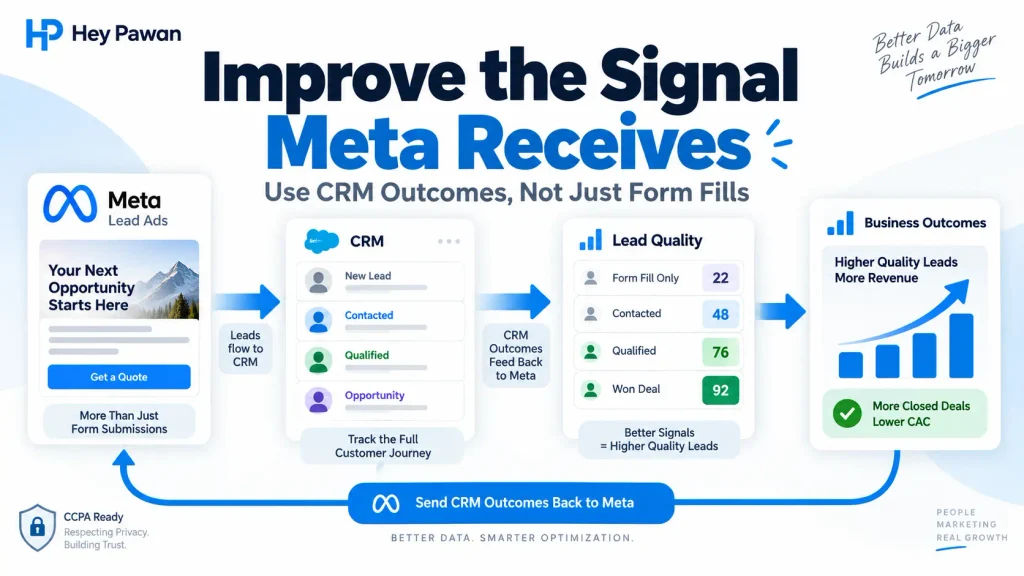
Where reliable sales or CRM data exists, downstream outcomes can give Meta a stronger picture of lead quality than form submissions alone.
Meta’s current training on Conversions API for CRM explains that first-party CRM data can connect with Meta technologies so its ad delivery system can optimize for lead quality rather than only lead volume.
That could mean distinguishing an initial lead from a later qualified opportunity, depending on the business’s sales process and technical setup.
Meta also describes Advantage+ leads campaigns as using AI-enabled automation. Automation makes the quality of the optimization signal important. If Meta is learning from an event that does not represent business value, additional automation does not solve the underlying definition problem.
Not every advertiser needs the same CRM or Conversions API setup. Available outcome data, sales processes, technical resources, and data quality all matter.
Businesses handling California consumer data should also determine which privacy requirements apply to their circumstances. The California Attorney General’s CCPA guidance explains that the CCPA applies to qualifying businesses rather than automatically to every advertiser.
Judge Improvement by the Learning Loop, Not Lead Volume Alone
A competent freelancer should be able to show how evidence leads to the next campaign decision.
The process should look more like:
Finding → Interpretation → Change → Validation → Next Decision
Suppose the campaign produces a reasonable number of leads, but many are outside the actual service area. The finding is not simply “lead quality is bad.” The interpretation is that geography may be weakening commercial fit. A targeting or messaging adjustment can then be tested against the percentage of usable leads after the change.
Other useful evidence may include qualification rate, cost per qualified lead, dominant disqualification reasons, geographic mismatch, or later CRM stages where reliable data exists.
Raw CPL still has value, but a cheaper lead is not automatically an improvement if fewer enquiries become legitimate opportunities.
Businesses that also need help evaluating account access, ownership, contracts, or general provider due diligence can use Hey Pawan’s digital marketing freelancer hiring checklist instead of turning Meta campaign evaluation into a generic hiring exercise.
If your Meta campaigns are producing leads but you cannot clearly connect them with qualified opportunities, Hey Pawan can review the current setup, customer geography, conversion path, lead definition, and available downstream data. Pawan Kumar works as one independent digital marketing professional with 10+ years of experience. The next step should be based on what the evidence shows, not a predetermined campaign package.
Frequently Asked Questions
Can different services use different definitions of a qualified Meta lead?
Yes. A business offering several services may need different qualification criteria when customer type, eligibility, geography, or commercial value genuinely differs. Those rules should still be documented and applied consistently enough to compare performance meaningfully.
What if there are too few qualified leads to create a useful optimization signal?
Do not treat limited outcome data as stronger evidence than it is. Improve tracking and lead classification first, use the strongest reliable conversion signal currently available, and reassess downstream optimization as more qualified outcomes accumulate.
Should Meta Instant Form leads and website leads use the same qualification criteria?
The core definition should reflect business value, regardless of where the lead is captured. However, Instant Forms and website forms may collect different information, so the way qualification is implemented and interpreted can vary by source.
How should spam, duplicate, or unreachable Meta leads be treated?
Classify them separately from wrong-service, out-of-area, or low-intent leads. Combining all failed enquiries into one “bad lead” category makes diagnosis harder because different failure types require different corrective actions.
Can the definition of a qualified lead change after sales feedback?
Yes, when credible sales evidence shows that the existing criteria no longer represent business value accurately. Changes should be documented so historical comparisons remain understandable and campaign reporting does not shift definitions without explanation.
Sources
- Meta Blueprint: Improve Lead Quality With Meta Conversions API for CRM
https://metaspark.facebookblueprint.com/student/path/253141-conversions-api-crm - Meta Blueprint: Meta Advantage+ Leads Campaigns: Generating High-Quality Leads With AI
https://www.facebookblueprint.com/student/page/665109 - California Department of Justice, Office of the Attorney General: California Consumer Privacy Act (CCPA)
https://www.oag.ca.gov/privacy/ccpa