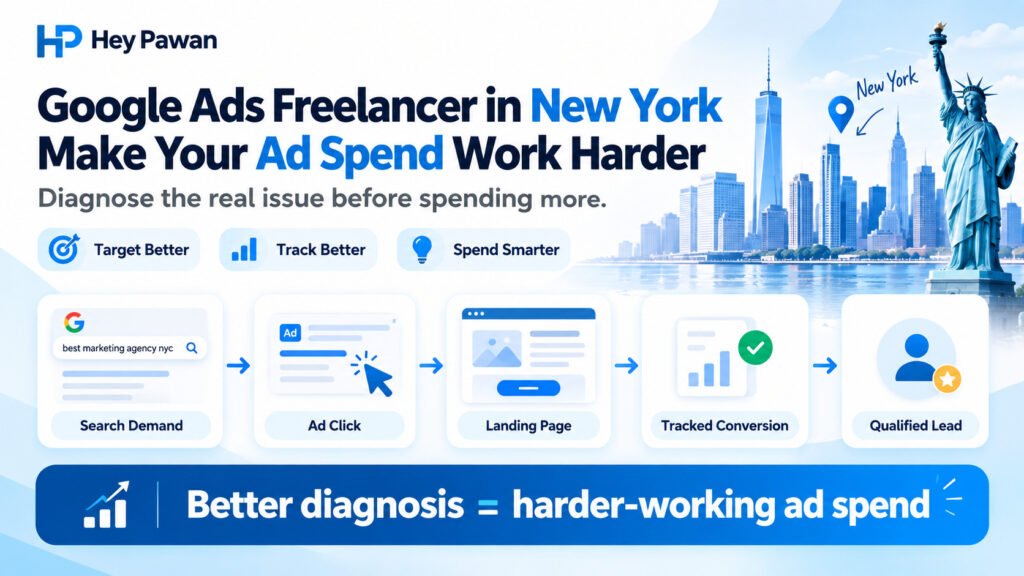
Hiring a Google Ads Freelancer New York businesses can work with is not only about finding someone who knows bidding, keywords, and campaign settings. The more important question is whether the freelancer can identify what is actually limiting performance, explain what they can control, and separate advertising problems from issues that belong elsewhere in the business.
Making ad spend work harder starts with assigning the right responsibility to the right problem.
What Does “Make Your Ad Spend Work Harder” Actually Mean?
Making ad spend work harder means improving the connection between advertising costs and meaningful business outcomes, not simply producing cheaper clicks or more activity inside Google Ads.
A campaign can generate more clicks while attracting the wrong prospects. It can report more conversions while measuring actions that have little commercial value. It can also produce genuine leads that never become customers because the follow-up process is weak.
Google Ads distinguishes between primary and secondary conversion actions. Primary actions can be used for bidding when their associated goal is selected, while secondary actions are generally used for observation. Google Ads guidance on primary and secondary conversion actions
That makes the first question practical: What outcome should the account actually optimize toward?
For one business, that may be a completed purchase. For another, it may be a qualified enquiry, booked consultation, or another action with real business value.
Google Ads Freelancer New York: Who Should Control What?
A Google Ads freelancer should control campaign decisions within the agreed account scope, while the business still owns commercial decisions, operational limitations, and many downstream customer outcomes.
A useful way to define the relationship is to separate direct freelancer control from business inputs and shared decisions.
| Performance Area | Freelancer’s Role | Business or Shared Input |
| Search relevance | Review reported search terms, targeting, keywords, and exclusions | Define which enquiries and customer intents are commercially relevant |
| Campaign structure | Organize campaigns and targeting around agreed priorities | Confirm priority products, services, and markets |
| Geographic targeting | Configure locations, exclusions, and relevant location options | Define where customers can realistically be served |
| Conversion measurement | Review and configure agreed conversion actions and measurement | Define which actions represent genuine business value |
| Ad messaging | Align ads with search intent and the agreed offer | Confirm pricing, availability, promises, and offer accuracy |
| Landing pages | Identify ad-to-page mismatches and recommend changes | Approve or implement website, offer, or CRO changes |
| Lead quality | Investigate campaign patterns linked to weak leads | Provide qualification and sales feedback |
| Budget and bidding | Manage bidding and make evidence-based budget recommendations | Define affordable spend, margins, capacity, and commercial limits |
Google’s Search Terms report can show reported search terms that triggered ads and how those terms performed. It can also help identify searches that may need to be excluded as negative keywords. Google Ads Search Terms guidance
The goal is not to transfer every business responsibility to the freelancer. It is to make ownership clear enough that problems can be diagnosed instead of blamed on the wrong part of the process.
Separate Google Ads Problems From Business-Side Problems
When results are weak, identify where the customer journey is breaking before deciding that the Google Ads account itself is the problem.
A practical diagnostic path is:
Search Demand → Ad → Landing Page → Tracked Action → Qualified Outcome → Customer
If irrelevant searches are consuming spend, the problem may involve targeting, search terms, or exclusions.
If relevant users click an ad but the landing page does not match what the ad promised, the problem may involve the page, message, or offer. Google recommends maintaining consistency between keywords, ads, and landing pages so users find the information or action they expected. Google Ads landing-page optimization guidance
If Google Ads reports conversions but the sales team says the leads are poor, both campaign quality and measurement need to be examined. For suitable lead-generation setups, Google Ads can support downstream measurement such as qualified or converted leads when appropriate business data is available. Google Ads enhanced conversions for leads guidance
The useful question is:
Where did the journey break, and who can influence that point?
That produces a better decision than assuming every weak business result is automatically a PPC management failure.
How Should New York Geography Affect Campaign Management?
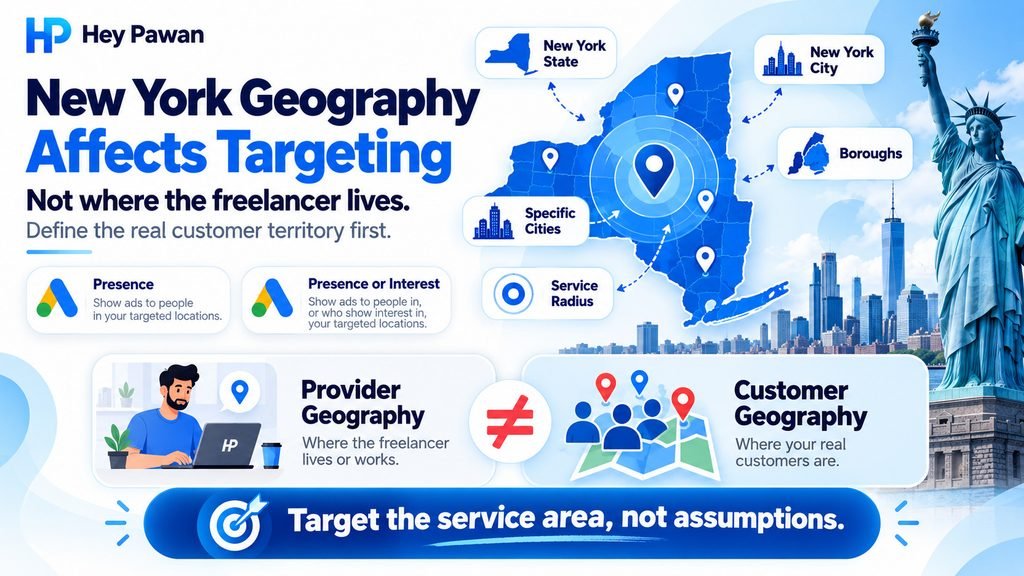
New York should affect where potential customers are targeted, not create an assumption that the person managing the account must physically live in New York.
The business first needs to define its real commercial territory.
That could mean:
- New York State
- New York City
- selected boroughs
- specific cities
- a service radius
- another defined service area
Google Ads supports geographic targeting and exclusions, but location targeting is not perfectly precise. Google describes it as a best-effort system based on available location signals. Google Ads geographic targeting documentation
Location options also matter. Google distinguishes broader Presence or Interest targeting from Presence targeting for advertisers who want to limit reach to people likely to be in or regularly in the selected locations. Google Ads advanced location options
A local service business that only serves people physically within a defined area may therefore need a different approach from a company that can benefit from customers researching New York from elsewhere.
The important distinction is between provider geography and customer geography. The second one affects campaign targeting far more directly.
What Should You Understand Before Committing More Ad Spend?
Before committing additional budget, the business should understand what is working, what remains uncertain, who owns the unresolved issue, and what evidence will be used to evaluate the next decision.
A Google Ads freelancer should be able to explain:
- what problem has been identified
- what data or evidence revealed it
- whether the cause is inside Google Ads
- what information is still needed from the business
- what change was made or recommended
- what should be reviewed afterward
Google Ads includes Change History, which allows account and campaign changes, including who made certain changes, to be reviewed. Google Ads Change History documentation
This creates useful accountability. Campaign management should not become a stream of unexplained changes.
Timing matters too. Automated bidding and conversion-based optimization should not always be judged immediately after a major change. Google recommends considering factors such as conversion delay and significant campaign changes when measuring Smart Bidding performance. Google Ads Smart Bidding performance guidance
The objective is not constant activity. It is making changes for a reason and then evaluating the right evidence.
When Is Independent Google Ads Support the Right Scope?
Independent Google Ads support can make sense when a business wants direct communication and campaign ownership from one specialist and the work fits realistically within that person’s scope.
Some businesses mainly need:
- an account audit
- ongoing Google Ads management
- conversion tracking review
- search campaign optimization
- landing-page recommendations
- PPC reporting and analysis
Other situations may also require substantial development, CRM work, creative production, sales-process improvements, or broader marketing support.
The provider label should not determine the scope. The actual problem should.
For businesses that want PPC support alongside tracking, landing-page, and broader digital marketing review, Hey Pawan’s PPC and Paid Advertising Services page explains the wider areas that can be reviewed.
If you are considering Google Ads support, share your website, the product or service you want to promote, your actual New York target area, whether campaigns are already running, the conversion that matters most, and the main problem you are trying to solve. Pawan Kumar works as an independent digital marketing professional and can review whether the issue fits his PPC scope.
Frequently Asked Questions
Can a freelancer improve Google Ads without increasing the budget?
Potentially. Search relevance, geographic targeting, conversion setup, ad messaging, or landing-page alignment may need attention before additional spend is justified. Improvement is not guaranteed, but increasing budget should not automatically be the first response to weak performance.
Should I share lead-quality or sales feedback with my Google Ads freelancer?
When practical, yes. Campaign data can show clicks and recorded conversions, but business feedback helps distinguish a useful enquiry from an irrelevant or low-quality lead. That information can help the freelancer investigate related searches, locations, ads, pages, and conversion signals.
Should an existing Google Ads account always be rebuilt from scratch?
No. A rebuild should have a clear reason. Existing campaign data, conversion history, search-term patterns, and Change History may contain useful evidence. The freelancer should first determine what can be preserved, what needs restructuring, and what is actually causing the problem.
Sources
- Google Ads Help: Primary and secondary conversion actions. View source
- Google Ads Help: Search Terms and negative keyword guidance. View source
- Google Ads Help: Optimize ads and landing pages. View source
- Google Ads Help: Enhanced conversions for leads. View source
- Google Ads Help: Geographic targeting. View source
- Google Ads Help: Advanced location options. View source
- Google Ads Help: Change History. View source
- Google Ads Help: Measuring Smart Bidding performance. View source