Knowing how to create an SEO content brief is not about filling a document with keywords, word counts, and competitor URLs. A useful brief should remove the strategic decisions a writer should not have to guess.
By the time you hand it over, the writer should understand who the article is for, what search intent it must satisfy, what it needs to cover, what makes it different, which claims need evidence, and what a successful first draft looks like.
Before you start, have one target topic and primary keyword, access to the current search results and relevant existing website content, plus any brand guidelines, editorial requirements, or source material the writer needs to follow.
Start by Defining What the Article Must Accomplish
Before researching headings or filling out a template, define the job of the page.
At the top of your brief, record:
- Primary keyword: The main search query the page should address.
- Search intent: What the searcher is actually trying to understand, compare, solve, or complete.
- Target audience: Who needs the information and how much they are likely to know already.
- Content type: Tutorial, comparison, service page, guide, checklist, or another appropriate format.
- Reader problem: The specific issue bringing someone to the page.
- Expected result: What the reader should know or be able to do after reading.
- Working title: A direction for the writer, not necessarily the final title.
- Existing-content check: Whether another page on the site already serves substantially the same query and intent.
The last point matters because creating another article around a slightly different keyword does not automatically justify a new URL. Check your existing site before assigning the page.
For broader guidance on optimizing an existing page after the draft is complete, see my guide to on-page SEO for search and AI visibility.
A successful first stage should leave you with a short statement such as:
This article helps a small-business owner understand how to build a writer-ready SEO brief before commissioning an article.
That is much more useful to a writer than simply labeling the intent “informational.”
How to Create an SEO Content Brief From SERP Evidence
The next step is to examine the current search results and convert what you find into editorial decisions.
Search the exact primary query and review several representative results. You are looking for patterns, not an outline to copy.
Note:
- which content formats dominate;
- which reader problems appear repeatedly;
- which topics are essential to understanding the subject;
- which questions come up frequently;
- what examples or evidence competitors use;
- where explanations are shallow, repetitive, or missing.
Google’s people-first content guidance recommends producing useful, original material rather than simply rehashing what other pages already say. Google’s helpful content guidance
So instead of writing:
Competitors use H2s about templates, keywords, and word count. Use the same H2s.
Turn the research into a decision:
Template intent matters, so explain the fields a usable brief needs. However, keep the article focused on creating the brief rather than turning it into a template library.
That is the difference between collecting SERP observations and actually briefing a writer.
As you research, classify related topics as:
- must cover;
- merge into another section;
- supporting detail;
- FAQ;
- separate article;
- omit.
Do not make every related query an H2. Google’s SEO Starter Guide also notes that there is no ideal number of headings or magical content length that a page must meet. Google SEO Starter Guide
Turn the Research Into Instructions the Writer Can Follow
A writer does not need a dump of SEO data. They need clear instructions derived from that data.
Your SEO content brief should normally cover the following areas when relevant.
Article identity
Include the primary query, audience, intent, reader problem, expected outcome, and article angle.
Required coverage
List the major sections or topics that genuinely need to be addressed. For each major section, explain what it should accomplish rather than providing only a heading.
For example:
Weak:
H2: Common SEO Content Brief Mistakes
Better:
Explain the mistakes that make a brief difficult to execute, especially unclear intent, excessive keyword requirements, missing evidence instructions, and conflicting constraints.
Evidence and sources
Tell the writer which claims need verification, whether authoritative sources are required, and whether the business has internal examples, data, screenshots, or subject-matter input available.
SEO and linking requirements
Include important related concepts, internal-link opportunities, external references where needed, and any title or meta-description deliverables.
Internal links should be contextual rather than inserted simply because another page exists. Google recommends links that help users and clearly communicate what the destination is about. Google SEO Starter Guide
Editorial boundaries
Specify terminology, tone, claims to avoid, geographic restrictions, and topics that should not expand into separate sections.
CTA direction
Explain what action should make sense after the reader’s problem has been solved. Do not ask the writer to insert sales messaging throughout an informational tutorial.
Acceptance criteria
Define what an acceptable first draft must accomplish.
You can also give the writer a word range when it helps communicate scope. Treat it as an editorial planning tool, not a ranking formula. Google explicitly states that there is no preferred minimum or maximum word count for ranking. Google SEO Starter Guide
Decide What the Brief Controls and What the Writer Controls
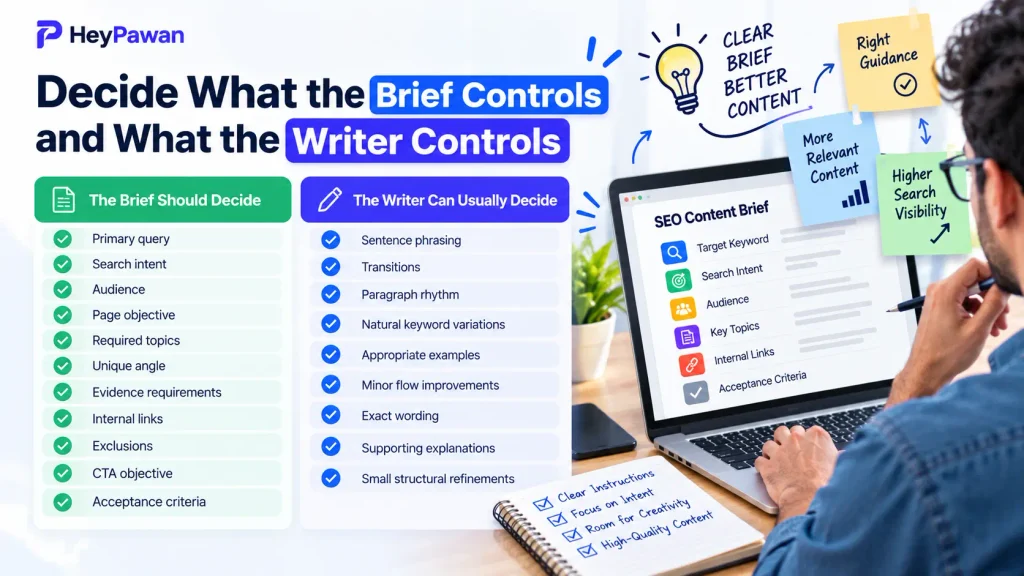
A strong brief removes strategic ambiguity without trying to write every sentence in advance.
A useful rule is:
| The Brief Should Decide | The Writer Can Usually Decide |
| Primary query | Sentence phrasing |
| Search intent | Transitions |
| Audience | Paragraph rhythm |
| Page objective | Natural keyword variations |
| Required topics | Appropriate examples |
| Unique angle | Minor flow improvements |
| Evidence requirements | Exact wording |
| Internal links | Supporting explanations |
| Exclusions | Small structural refinements |
| CTA objective | |
| Acceptance criteria |
This balance matters.
If the brief is too vague, the writer has to make strategic decisions without the necessary context. If it is too rigid, the document becomes a pre-written article that leaves little room for natural explanation.
Ahrefs makes a similar point in its guidance on content briefs: provide the context writers need without making the brief unnecessarily prescriptive. Ahrefs guide to content briefs
You may need tighter instructions for technical, regulated, or legally sensitive content. An experienced writer who already knows the brand may need less explanation.
Run a Writer-Ready Check Before You Hand Off the Brief
Before sending the document, test whether it can stand on its own.
A competent writer who was not part of your research should be able to answer these questions from the brief:
- Who is the page for?
- What problem or task does it address?
- What primary query controls the article?
- What search intent must be preserved?
- What topics must be covered?
- What should not be expanded?
- What evidence or sources are required?
- What makes this page different from existing results?
- What does an acceptable first draft look like?
If the writer needs your private research notes to answer any of those questions, the brief is not finished.
Also check for contradictory instructions, such as:
- asking for comprehensive coverage while imposing an unrealistic length;
- assigning an informational article but demanding aggressive sales copy throughout;
- targeting a global audience while inserting unsupported local claims;
- promising writer freedom while prescribing every paragraph;
- giving several “primary” keywords with different search intents.
If the resulting draft later misses expectations, inspect the brief before assuming the writing itself is the problem. Unclear audience, scope, evidence requirements, exclusions, or acceptance criteria can produce an off-target draft even when the writing is technically good.
This final check is what turns how to create an SEO content brief from a list of fields into a repeatable handoff process.
A clear brief cannot guarantee rankings or a perfect first draft, but it can make the assignment much easier to understand, execute, and review.
If you would rather have keyword research, SERP analysis, content planning, and SEO briefing handled directly for your business, you can review my SEO and AI Search services.
Frequently Asked Questions
What is the difference between an SEO content brief and a content outline?
An SEO content brief defines the assignment, including the audience, search intent, required coverage, evidence, links, exclusions, and goals. A content outline primarily organizes the sections of the article. An outline can therefore be one part of a larger brief.
Should an SEO content brief include exact H2s?
Only when specific headings are important to the intended structure or coverage. Otherwise, you can give section purposes and let the writer refine the wording. There is no Google requirement for a specific number of headings.
Should you give writers competitor URLs?
You can provide useful competitor pages as references, but also summarize what the writer is expected to learn from them. Sending URLs without context increases the risk of imitation instead of original analysis.
Can the same SEO content brief template be reused for every article?
You can reuse the core workflow or document structure, but the strategic instructions should change. Search intent, audience, evidence requirements, risks, page type, and writer familiarity can all affect how detailed a particular brief needs to be.
Who should create an SEO content brief?
The brief should be created or approved by the person responsible for the page’s SEO and editorial strategy. That may be an SEO professional, content strategist, editor, marketing lead, or the writer when the writer also owns the research and strategy.