If you are investing in AI SEO, the difficult question is not whether your website appeared once in ChatGPT, an AI Overview, or another AI-generated result. It is whether that visibility contributes to useful business outcomes. Hey Pawan is the professional brand of Pawan Kumar, an independent digital marketing freelancer, and the measurement approach I use is to separate visibility, citations, website visits, conversions, and lead quality rather than treating them as one number.
That distinction matters because AI Search creates several different signals. A page can be cited without receiving a click. A visitor can arrive from an AI assistant without converting. A form submission can be recorded without becoming a qualified lead.
Measure AI SEO as a chain of evidence. Track whether relevant pages appear in AI-supported search, whether they receive citations or mentions, whether users reach the website, what those visitors do, and whether those actions become qualified enquiries, purchases, bookings, or other business outcomes. No single dashboard currently provides a complete view across every AI platform.
What Does Measuring AI SEO Actually Mean?
AI SEO measurement means evaluating several connected stages of discovery instead of looking for one universal AI ranking.
The useful stages are:
- Visibility in relevant search or AI experiences.
- Mentions or citations of the business or website.
- Visits that reach the website.
- Meaningful website actions.
- Qualified commercial outcomes.
This distinction is important because each metric answers a different question.
An impression tells you that a page appeared. A citation tells you that content was referenced. A referral visit tells you someone reached the website. A conversion indicates that a tracked action occurred. A qualified lead tells you whether that action was commercially useful.
Google’s current guidance also makes clear that established SEO practices remain relevant to its generative Search features because AI Overviews and AI Mode use Google’s core Search ranking and quality systems.
AI SEO should therefore be measured alongside normal search performance rather than treated as a completely separate marketing channel.
Which AI SEO Metrics Matter Most?
The most useful metrics depend on the business objective, but five categories provide a practical starting framework.
| Metric | What It Tells You |
| AI visibility | Whether relevant content appears in monitored AI experiences |
| Citation or mention | Whether the website or brand is referenced |
| Referral visit | Whether someone clicked through to the website |
| Conversion | Whether the visitor completed an important action |
| Qualified outcome | Whether the action created real business value |
These metrics should not be treated as interchangeable.
A growing citation count can show that content is being used in AI-generated answers, but it does not prove that website traffic increased. Bing explicitly states that its AI citation metrics do not measure rankings, authority, traffic, engagement, or the importance of a page within an answer.
The same principle applies farther down the funnel. More traffic does not automatically mean better traffic, and more conversions do not automatically mean more qualified customers.
For a service business, a smaller number of commercially relevant enquiries may matter more than a large increase in informational visits.
How Can You Measure Google AI Overviews and AI Mode?
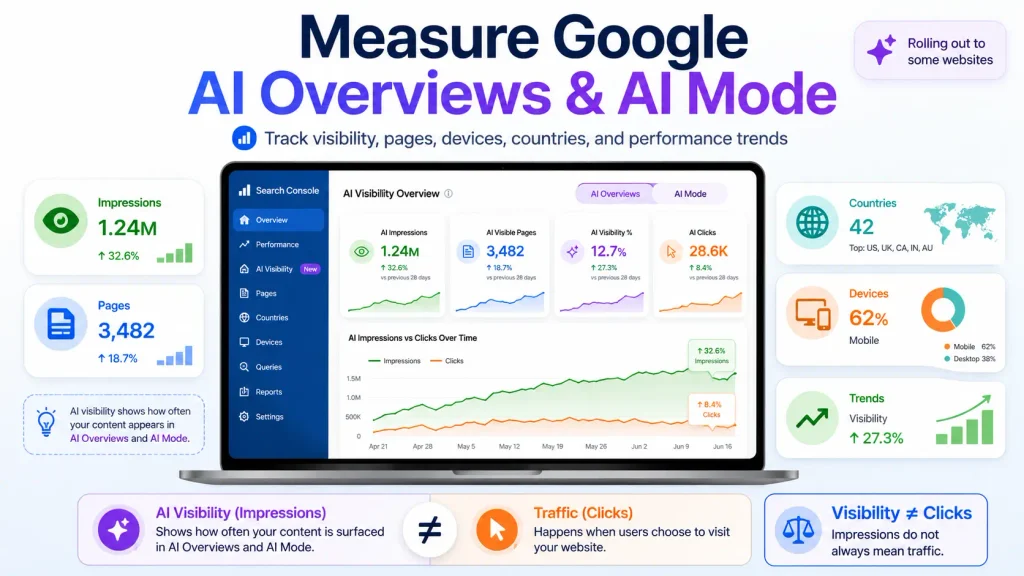
Google now provides dedicated Search Console reporting for visibility in generative AI Search features, but availability is still being rolled out.
On June 3, 2026, Google announced Search Generative AI performance reports in Search Console. The reports can show:
- Impressions in generative AI features
- Pages that appeared
- Countries
- Devices for Search reporting
- Performance trends over time
Google says these reports cover generative AI features such as AI Overviews and AI Mode and are being introduced to a subset of websites before wider availability.
This creates an important measurement distinction.
If the dedicated report is available, you can examine which pages are receiving generative AI visibility and whether that visibility is changing.
If the report is not available in your account yet, its absence should not be interpreted as evidence that your site never appears in AI-supported Search.
Search Console visibility also should not be confused with website traffic. An impression can occur without a user clicking through to the site.
Does GA4 Track Traffic From ChatGPT and Other AI Assistants?
Yes. Google Analytics now has a dedicated AI Assistant channel for recognized referral traffic from AI assistants.
Google introduced the channel on May 13, 2026. Recognized visits can receive an ai-assistant medium and appear under the AI Assistant default channel. Google specifically identifies services such as ChatGPT, Gemini, and Claude in its documentation.
However, there is an important limitation.
Google’s current channel definitions state that the AI Assistant channel excludes Google’s own AI Overviews and AI Mode. Those Google Search visits are included within Organic Search instead.
That means you should not compare Search Console’s AI visibility report directly with GA4’s AI Assistant channel and expect the numbers to describe the same event.
They answer different questions:
- Search Console can help show Google Search visibility.
- GA4 can show identifiable visits reaching your website.
- Conversion tracking can show what those visitors do afterward.
In my experience, this distinction should be checked before interpreting a change as an AI SEO gain or loss. Two reports can both be accurate while measuring different stages of the customer journey.
How Can You Measure AI Citations Beyond Google?
Cross-platform AI visibility usually requires more than one data source because there is no single first-party dashboard showing every time your content appears across ChatGPT, Gemini, Claude, Perplexity, Copilot, and other AI systems.
Microsoft provides one useful first-party example through Bing Webmaster Tools.
Its AI Performance report can show:
- Total citations
- Cited pages
- Grounding queries
- Page-level citation activity
- Visibility trends
Microsoft also explains that grounding queries are grouped phrases associated with retrieval and citation activity, not complete user prompts. The data is aggregated and is not a complete log of every AI answer.
Third-party AI-monitoring products can provide additional directional information, but their visibility scores should be interpreted according to the prompts, platforms, locations, and sampling methods they use.
A practical monitoring setup should therefore keep a stable set of commercially relevant questions and compare trends over time rather than treating one isolated AI response as proof of performance.
How Hey Pawan Connects AI Visibility to Business Outcomes

AI visibility should be treated as an upstream signal. The business objective is usually farther down the journey.
For an SEO and AI Search project, I would normally want to understand:
- Which commercial topics matter
- Which pages should answer those topics
- Whether those pages are visible
- Whether the site receives identifiable traffic
- Whether visitors reach important conversion points
- Whether enquiries are commercially relevant
This prevents a common reporting mistake: celebrating an increase in citations while ignoring whether the cited pages support the business.
Conversion tracking matters here. A service business might track forms, calls, bookings, or other meaningful actions. An ecommerce business may focus more heavily on purchases and revenue-related events.
Lead quality should still be reviewed separately where possible. A form submission from an AI-assistant visitor is a measurable conversion, but it does not become a useful lead until the business determines that the enquiry fits the service.
Attribution also has limits. Users may discover a company through an AI answer, return later through branded search, and convert during another session. No single analytics platform will always reconstruct that journey perfectly.
Practical Example: From AI Visibility to a Qualified Enquiry
Consider a hypothetical professional-service company that wants visibility for a commercially important customer question.
The measurement path could look like this:
- The company identifies a question commonly asked before someone chooses its service.
- A relevant educational or service page begins appearing in monitored AI results.
- Search Console shows Google generative AI visibility where the dedicated report is available.
- Bing Webmaster Tools records citations for relevant grounding queries.
- GA4 records identifiable visits from supported AI assistants.
- Some visitors reach a service page and submit an enquiry.
- The business reviews whether those enquiries are relevant and commercially useful.
No single step proves success by itself.
The useful evidence comes from connecting the stages and observing whether relevant visibility is increasingly associated with useful customer activity.
This framework also helps diagnose problems. Strong citations with no visits may indicate that users are receiving enough information without clicking. Good traffic with no enquiries may point toward weak page intent, messaging, conversion paths, or lead fit rather than an AI visibility problem.
When Is AI SEO Data Good Enough to Guide a Decision?
AI SEO data becomes useful for decision-making when the measurement is consistent enough to reveal patterns rather than isolated observations.
Before expanding or reducing activity, check whether:
- the same relevant topics are being monitored consistently
- important commercial pages are included
- Search Console and analytics tracking are configured correctly
- citations and website visits are being kept separate
- conversions represent meaningful actions
- lead quality is reviewed where possible
- the comparison period is long enough for useful patterns to emerge
- major platform or website changes are documented
Be cautious when conclusions depend on one prompt, one citation, one day of referral traffic, or one proprietary visibility score.
AI-generated results can vary because of user context, location, changing models, retrieval systems, updated web content, and platform changes. Bing also warns that changes in citation activity are observational and cannot automatically be attributed to one content or model update.
The goal is not perfect attribution. It is enough reliable evidence to choose the next sensible action.
Need Help Making AI Search Measurement More Reliable?
If your website is appearing in Google or AI-supported discovery but you cannot tell whether that visibility is producing useful traffic or leads, Hey Pawan can help connect the SEO and measurement pieces.
I can review your website, Search Console, GA4 setup, important landing pages, conversion tracking, and current AI Search visibility to identify what can be measured reliably and what should be improved next.
Share your website, target market, and current SEO or AI Search challenge through the contact page.
Frequently Asked Questions
Can Google Search Console Measure AI Overviews and AI Mode?
Yes, where Google’s dedicated generative AI reporting is available. Search Console can show impressions, appearing pages, countries, devices, and trends for generative Search features such as AI Overviews and AI Mode. Google introduced the reports in June 2026 and is still rolling them out to a subset of websites, so not every property will necessarily have the dedicated view yet.
How Do I Set Up AI Traffic Reporting in GA4?
Start by checking the default channel reports for the AI Assistant channel. Google now automatically classifies recognized AI-assistant referrals using the ai-assistant medium. You can then analyze source, landing page, engagement, and conversions. Remember that Google’s AI Overviews and AI Mode are classified within Organic Search rather than the GA4 AI Assistant channel.
How Long Does It Take to Get Useful AI SEO Measurement Data?
There is no universal timeframe. It depends on existing visibility, site traffic, search demand, publishing frequency, AI citation activity, tracking quality, and how often relevant users interact with the business. Establish a baseline first, monitor a consistent question set, and avoid strategic conclusions from isolated citations or very small traffic samples.
What Affects the Cost of Setting Up AI SEO Measurement?
Cost depends on the existing analytics setup, number of websites or markets, conversion complexity, Search Console access, GA4 and GTM condition, CRM requirements, dashboard needs, and whether third-party AI-monitoring tools are required. A business with reliable tracking may need only reporting improvements, while incomplete measurement can require technical implementation before useful analysis is possible.
When Should I Get Professional Help With AI SEO Measurement?
Professional help is useful when Search Console, GA4, conversion tracking, AI citations, and actual sales outcomes cannot be reconciled confidently. It can also help when important events are missing or duplicated, attribution is unclear, or teams are making decisions from visibility scores without understanding what those metrics measure. The first step should be diagnosis rather than assuming a larger SEO engagement is required.
Sources
Google Search Central, Generative AI Performance Reports in Search Console
Google Search Generative AI performance reports
Google Search Central, Optimizing for Generative AI Features
Google generative AI Search optimization guidance
Google Analytics, New AI Assistant Traffic Measurement
Google Analytics AI Assistant update
Google Analytics, Default Channel Group Definitions
Google Analytics default channel documentation
Bing Webmaster Tools, AI Performance
Bing Webmaster Tools AI Performance documentation