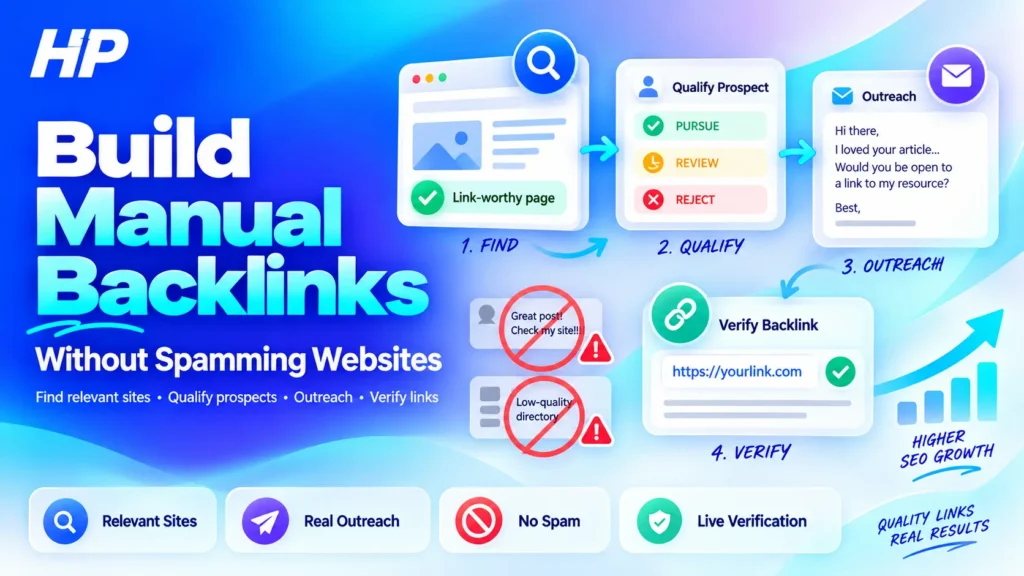
Manual Backlinks are links you deliberately pursue through outreach, partnerships, resource recommendations, or similar link-building activity. But manual does not automatically mean useful or safe. A person can still submit irrelevant directories, arrange excessive link exchanges, or request manipulative keyword-rich links.
A better process is to start with a page worth referencing, find relevant opportunities, qualify each prospect before outreach, and verify the resulting link after publication.
Manual Backlinks Are Not Automatically Safe Backlinks
Manual link building describes how you pursue a link, not whether that link deserves to exist.
Google’s spam policies identify several practices that can become link spam when they are primarily intended to manipulate search rankings. These include excessive link exchanges, automated link creation, low-quality directory links, paid links that pass ranking credit, and optimized links distributed through guest posts or forum comments.
So a backlink should not pass your quality check simply because:
- you found the website yourself;
- you contacted a real editor;
- the domain has a strong SEO metric;
- the placement was added manually.
Instead, judge the relevance, editorial context, real reason for the link, and how the placement is implemented.
Start With a Page That Gives Someone a Reason to Link
Do not begin by collecting hundreds of websites. Choose the exact page on your site that you want another publisher to reference.
Open that page as a normal visitor. Check that it is accessible, current, useful, and strong enough to support the outreach request.
Then complete this sentence:
Someone might reasonably reference this page because…
A credible reason could be that the page:
- contains original data or research;
- explains something missing from an existing source;
- provides a useful checklist, tool, or reference;
- can replace a broken or outdated resource;
- adds evidence to an article;
- is already mentioned by the publisher but not linked.
If the only reason is “I want a backlink for SEO,” improve the resource or choose another target before starting outreach.
How to Find and Qualify Manual Backlinks Before Outreach
Potential opportunities can come from topical searches, industry publications, competitor backlink research, resource pages, broken references, unlinked mentions, professional associations, or relevant directories.
Tools such as Ahrefs and Semrush can speed up discovery, but a tool export is only a candidate list. It is not a list of automatically approved websites.
Inspect each serious prospect before finding contact information.
Use a Pursue, Review, or Reject Check
Ask these six questions.
1. Is the site or page relevant?
The publisher should serve an audience that could reasonably care about your resource. Relevance may be topical, audience-based, or geographic when local context genuinely matters.
2. Is there a specific page-level fit?
Identify where your resource could naturally belong, such as an existing article, resource page, broken citation, business mention, or membership page.
3. Does the website appear editorially legitimate?
Look beyond authority metrics. Check whether the site has a coherent purpose, useful content, sensible outbound linking, and material that appears written for actual readers rather than primarily to host commercial links.
4. Is there a genuine linking reason?
You should be able to explain in one sentence how the proposed reference helps the publisher’s page or audience.
5. Are there signs of manipulative placement?
Be cautious with sites dominated by unrelated paid insertions, keyword-heavy outbound links, indiscriminate guest posts, low-quality directory listings, or systematic reciprocal links.
6. Would the placement still make sense without ranking credit?
If a citation, sponsorship, directory listing, expert contribution, or business relationship has no meaningful purpose beyond passing SEO authority, reconsider it.
Classify each opportunity:
- PURSUE: relevant, useful, and editorially sensible.
- REVIEW: potentially legitimate but needs closer examination.
- REJECT: irrelevant, manipulative, or attractive mainly because of perceived SEO authority.
A smaller qualified prospect list is more useful than hundreds of unreviewed domains.
How to Ask for a Backlink Without Spamming Websites
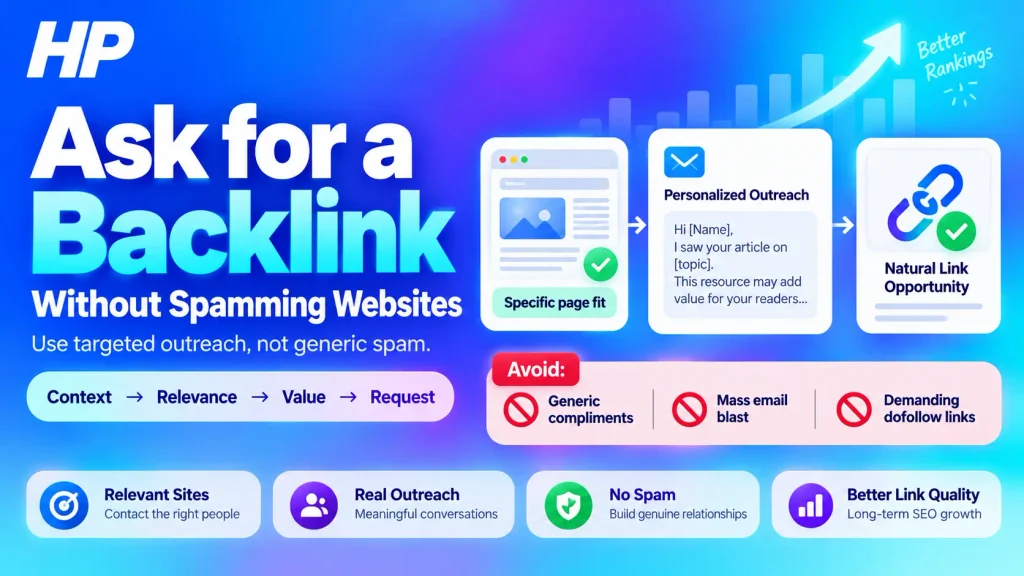
Contact the person responsible for the relevant content and explain why you are approaching that specific website or page.
Depending on the opportunity, the right contact may be an author, editor, content manager, small-site owner, partnership contact, or association administrator.
Keep the message built around four elements:
Context → Relevance → Value → Request
Explain what prompted the outreach, why your resource fits, what it adds for their readers, and the single action you are requesting.
Avoid:
- generic compliments;
- fake personalization;
- long introductions about your business;
- demands for a “dofollow” link;
- requests for exact-match commercial anchors;
- several unrelated URLs;
- repeated unanswered follow-ups.
Use this pre-send test:
Could I send this exact message unchanged to hundreds of unrelated sites?
If yes, the targeting is probably too weak.
One polite follow-up can be reasonable. If there is still no interest, move on.
Know When a Manual Backlink Opportunity Should Be Rejected
Do not accept a placement simply because the publisher agrees to provide one.
| Situation | Practical Direction |
| Relevant editorial citation | Pursue |
| Broken-link replacement that genuinely fits | Pursue |
| Existing unlinked business or brand mention | Pursue |
| Legitimate industry or professional directory | Review |
| Genuine sponsorship | Review and confirm proper qualification |
| Natural business partnership | Review |
| Irrelevant site selected mainly for DA or DR | Reject |
| Low-quality general directory | Reject |
| Systematic reciprocal exchange | Reject |
| Forum-comment backlink campaign | Reject |
| Automated backlink submission | Reject |
Paid placements require context. Google allows legitimate advertising and sponsorship, but paid links should be appropriately qualified. Google prefers rel=”sponsored” for paid placements, while nofollow is also accepted.
Google guidance for qualifying outbound links
Not every reciprocal link, guest contribution, or directory listing is automatically spam. The issue is whether the arrangement serves a genuine editorial, advertising, business, membership, or user purpose instead of primarily manufacturing ranking signals.
Avoid forcing exact-match anchors as well. Google’s link guidance recommends descriptive, relevant, reasonably concise anchor text rather than unnatural keyword stuffing.
Verify Every Manual Backlink After It Goes Live
Do not consider a placement complete because someone tells you the backlink has been published.
Open the actual referring page and check:
- the page is publicly accessible;
- the link is visible and clickable;
- it reaches the intended destination URL;
- the anchor text fits naturally;
- the surrounding content describes the destination accurately;
- there is no unexpected redirect;
- any relevant rel qualification is appropriate;
- the placement matches what was agreed;
- the referring URL and verification date are recorded.
For an ordinary link, Google does not require a special rel value. sponsored is recommended for paid placements, while ugc is recommended for user-generated links such as comments and forum posts.
For secondary monitoring, open the Links report in Google Search Console and review its External links tables, including top linked pages, top linking sites, and linking text.
However, Search Console is not an exhaustive backlink-verification system. Google says the report shows a sample, may omit links, can include links discovered in the past that have since disappeared, and does not indicate whether an individual link is nofollow.
Google Search Console Links report documentation
The correct verification order is:
Inspect the live page → record the placement → use Search Console or backlink tools for ongoing monitoring.
If a new backlink does not appear in Search Console, that alone does not mean the link failed.
If you are unsure which pages deserve promotion, which opportunities should be rejected, or whether backlink acquisition is the right SEO priority for your website, Hey Pawan can help review the wider SEO strategy directly with an independent digital marketing professional with 10+ years of experience.
Frequently Asked Questions
Can a manual backlink be nofollow?
Yes. “Manual” describes how the backlink was pursued, not its rel attribute. A manually acquired link can be a regular link, nofollow, sponsored, or ugc, depending on the context.
What should I record in a manual backlink tracking sheet?
At minimum, record the target URL, prospect site, relevant referring page, contact, outreach date, response, live backlink URL, placement status, and verification date. Add anchor or rel notes when they are useful for QA.
What should I do if a backlink disappears later?
Open the original referring page first. The publisher may have updated the article, changed the URL, removed the page, or made an editorial change. Update your tracking record rather than assuming every placement is permanent.
Can local businesses use the same manual backlink process?
Yes. The process is the same, but geographic relevance can become another qualification factor. A legitimate regional publication, association, chamber, supplier, or community resource may be relevant when it genuinely serves the same local audience.
Should I disavow every suspicious backlink pointing to my website?
No. Do not treat disavowal as routine cleanup for every unfamiliar link. Suspicious-link evaluation and use of Google’s Disavow Tool require more context and are better handled as a dedicated backlink-audit task.
Sources
- Google Search Central, Spam Policies
View source - Google Search Central, Qualify Outbound Links
View source - Google Search Central, Link Best Practices
View source - Google Search Console Help, Links Report
View source - Ahrefs, Link Prospecting Guide
View source - Ahrefs, Link Outreach Guide
View source - Semrush, Link Building Outreach
View source